
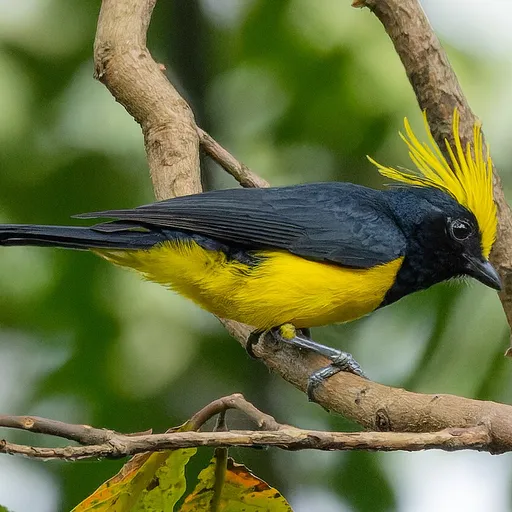
Sultan Tit
Melanochlora sultanea
Least Concern
Overview
The sultan tit (Melanochlora sultanea) is an Asian forest bird and the largest species of tit, standing between 20 and 20.5 cm in length. It is the only member of the monotypic genus Melanochlora and is currently classified as Least Concern on the IUCN Red List.
Identification
- Size: The largest of all tits, measuring 20–20.5 cm in length with a wingspan of 9.4–11.5 cm and a weight of 34–49 g.
- Plumage: Males exhibit brilliant yellow foreheads and crests (except in one subspecies which is glossy black) contrasting with deep black, green-glossed upperparts and yellow underparts; females possess duller greenish-brown upperparts and olive-green throats.
- Structure: Features a recumbent crest that raises when the bird is alert, a black bill, grey legs, and dark brown irises.
- Sound: Vocal calls include rattling 'chi-dip, tri-trip' notes, harsh explosive hisses, and squeaky repeated 'wheet' whistles.
Habitat
This species inhabits larger trees within forest canopies, frequently ranging into higher undergrowth and bamboo areas. It is widely distributed throughout its large range and can be found in protected areas such as the Buxa Tiger Reserve, where densities may reach approximately 15 individuals per square kilometre.
Diet
The sultan tit forages in the mid and upper tree canopies for a diet consisting mainly of invertebrates such as grasshoppers, mantises, web spiders, and caterpillars, supplemented by berries, fruits, and seeds. It typically forages singly or in small groups and may join mixed-species flocks of up to twelve individuals to feed.
Did you know?
Unlike typical members of the family Paridae, the sultan tit has exposed nostrils that are not covered by feathers. Additionally, these birds display an unusual panic response to unfamiliar noises or the presence of other species when kept in captivity.
Sources
- Wikipedia · CC BY-SA 4.0
- Wikidata · CC0 1.0