
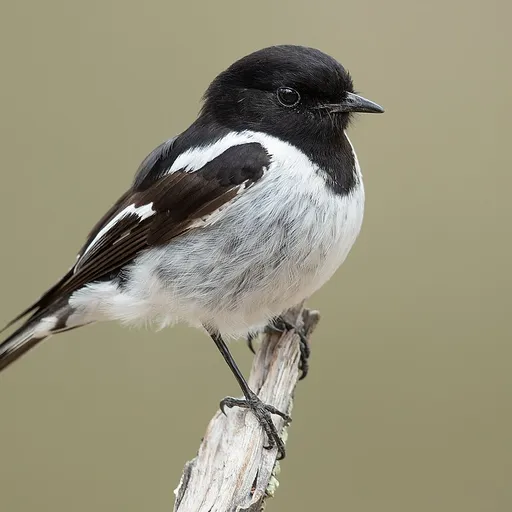
Hooded Robin
Melanodryas cucullata
Least Concern
Overview
The hooded robin (Melanodryas cucullata) is a small passerine bird native to Australia that belongs to the family Petroicidae. It is sexually dimorphic, with males displaying a distinctive black-and-white plumage and females appearing as nondescript grey-brown.
Identification
- Males are approximately 16 cm long and feature a black 'hood' on the head and neck, a white stripe on the shoulder, white underparts, and black wings with white bars.
- The square-ended tail has white tips underneath and distinctive white panels on the dorsal side that are clearly visible in flight.
- Females are undistinguished grey-brown above with a pale grey throat, while juvenile males may retain lighter wing bars but lack the full black hood until maturity.
- Though normally quiet, males may call in the early morning.
Habitat
The species prefers dry open forests that combine acacia and eucalypts with shrubs offering perching positions close to the ground, alongside native grass cover. It is found in the northern arid, southwestern arid, and central arid regions of Australia, as well as the south-eastern states, but is absent from Tasmania, the Nullarbor Plain, Cape York, and the Simpson Desert.
Diet
The hooded robin primarily feeds on invertebrates such as small lizards and arthropods, which it catches by pouncing from exposed perches close to the ground. Thick patches of exotic grasses and extensive grassless areas are known to limit its foraging success.
Did you know?
Both sexes perform injury-feigning displays, including tumbling along the ground, to distract potential predators and humans from occupied nests.
Sources
- Wikipedia · CC BY-SA 4.0
- Wikidata · CC0 1.0