
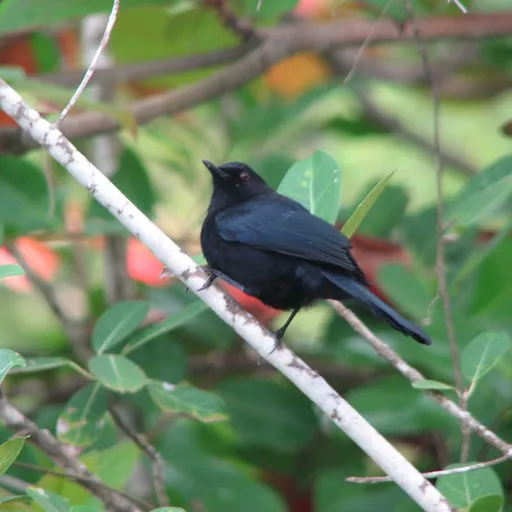
Black Catbird
Melanoptila glabrirostris
Least Concern
Overview
The black catbird, Melanoptila glabrirostris, is a small songbird in the family Mimidae and the smallest of the mimids. It is endemic to the Yucatán Peninsula and is assessed as Least Concern on the IUCN Red List.
Identification
- Plumage: Glossy black with a purplish sheen overall, though the rectrices and coverts have a greenish sheen; females are less glossy and juveniles are brownish-gray with mottling.
- Size: 19–20.5 cm in length and 31.6–42 g in mass, with short, rounded wings and a relatively long tail.
- Bill and Legs: Black legs and a short, black bill that is shorter than the head, with a straight culmen that decurves toward the tip.
- Song: A mix of harsh notes and clear flute-like whistles, often interspersed with metallic clicking buzzes and repeated in phrases.
Habitat
The species is endemic to the Yucatán Peninsula, occurring as far south as Campeche, northern Guatemala and northern Belize, as well as several offshore islands. It inhabits low-elevation areas ranging from semi-arid shrubland and abandoned farmland to humid woodland with thick understory. It is primarily sedentary, though it may make localized seasonal movements away from drier northern regions in late summer.
Diet
Thought to be an omnivore like its close relatives, the black catbird is known to eat the fruits of Bursera simaruba and Ficus cotinifolia. No specific studies have been conducted on its feeding ecology.
Did you know?
Unlike many other members of the mimid family, the black catbird is not known to imitate the calls of any other species. Its genus name, Melanoptila, is a compound of Greek words meaning 'black plumage', directly referencing its dark appearance.
Sources
- Wikipedia · CC BY-SA 4.0
- Wikidata · CC0 1.0