
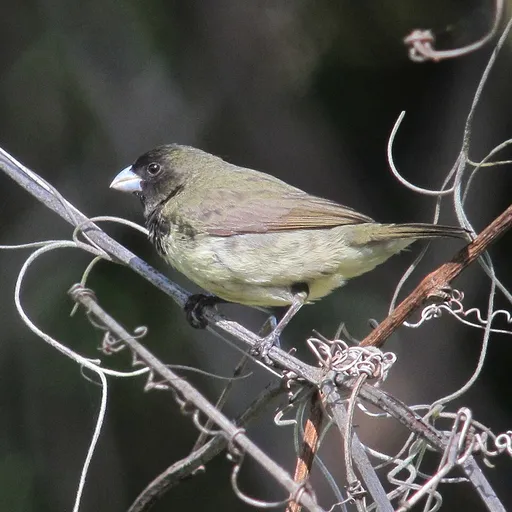
Black-faced Grassquit
Melanospiza bicolor
Least Concern
Listen
XC748000 · Rosa Elena Albornoz · Chacao (near Caracas), Chacao, Miranda, Venezuela · CC0 1.0
Overview
The black-faced grassquit (Melanospiza bicolor) is a small bird in the family Thraupidae, comprising tanagers and allies. It is a resident species found across the West Indies, parts of northern South America, and various islands in the western Caribbean Sea.
Identification
- Males feature a black head, black underparts, and greenish upperparts, while females and juveniles are mostly drab olive-green with browner or grayer underparts.
- The species is sexually dimorphic with males possessing a black bill, whereas females have a dark maxilla and a paler mandible.
- All sexes share a dark iris and dusky pinkish legs, with the bird measuring 10.2 to 11.5 cm in length and weighing between 7 and 13 g.
- Vocalisations include an emphatic buzz followed by a second louder effort, as well as a soft musical 'tsip' or buzzy 'tse-tsee-tsee' phrases.
Habitat
The species primarily inhabits open arid to dry landscapes such as thorn scrub, cactus scrub, grassy areas adjoining woodlands, clearings, plantations, and gardens. In the Netherlands Antilles, it also occurs in mangroves, generally residing up to an elevational limit of 1,300 m.
Diet
The black-faced grassquit feeds primarily on seeds and, in the Netherlands Antilles, also includes cactus fruit in its diet. It forages on and near the ground, either singly, in pairs, or in small groups.
Did you know?
Males sometimes perform an aerial courtship flight during which they sing, vibrate their wings, and drift down. Their nests are globes made mostly of grasses that can be found on the ground among Opuntia cacti or in shrubs up to 2.5 m above the ground.
Sources
- Wikipedia · CC BY-SA 4.0
- Wikidata · CC0 1.0