
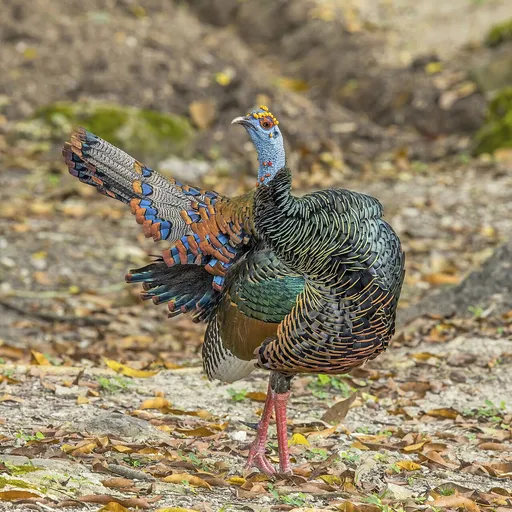
Ocellated Turkey
Meleagris ocellata
Near Threatened
Overview
The ocellated turkey (Meleagris ocellata) is a relative of the North American wild turkey that resides primarily in the Yucatán Peninsula of Mexico, with populations also found in parts of Belize and Guatemala. It is currently classified as Near Threatened by the IUCN due to land-use changes and unsustainable harvesting.
Identification
- Body feathers are a mixture of bronze and green iridescent colors, while upper wing coverts are rich iridescent copper.
- Tail feathers are bluish-grey with an eye-shaped, blue-bronze spot near the end, featuring a bright gold tip.
- Heads are blue with orange or red nodules, and legs are deep red, shorter and thinner than those of North American turkeys.
- Male vocalisations begin with low-frequency thumps resembling a small gasoline motor before building into a crescendo of bongo-like bass tones and high-pitched chops.
Habitat
This species lives exclusively within a 130,000 km² range in the Yucatán Peninsula, covering parts of the Mexican states of Quintana Roo, Campeche, Yucatán, Tabasco, and Chiapas. Its range also extends into the northern and western parts of Belize and northern Guatemala.
Diet
As a generalist feeder, the ocellated turkey consumes a wide variety of forage, including insects such as beetles, moths, and leafcutter ants, as well as grass seeds, nuts, and leaves. Males exhibit significantly higher feeding rates in January, prior to the onset of the breeding season.
Did you know?
Mayan folklore explains the bird's unique guttural thumping call as divine punishment from the Great Ancestor, Nohochacyum, for the turkey forgetting its debt to the nightjar who had secured the turkey's coronation as king of the birds.
Sources
- Wikipedia · CC BY-SA 4.0
- Wikidata · CC0 1.0