
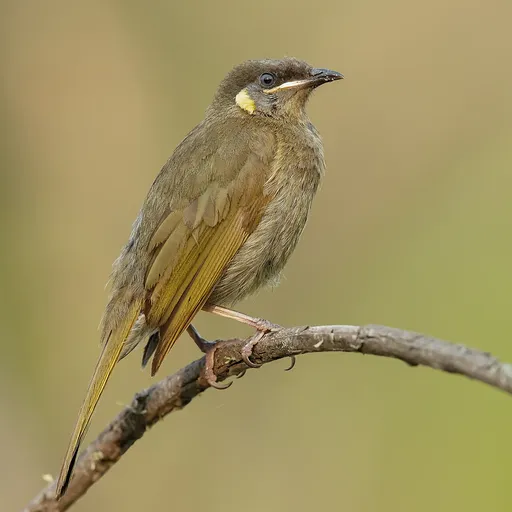
Lewin's Honeyeater
Meliphaga lewinii
Least Concern
Overview
Lewin's honeyeater (Meliphaga lewinii), also known as the Yellow-eared Honeyeater, is a small to medium-sized bird that inhabits the ranges along the east coast of Australia. It is a common and rather sedentary species, though some altitudinal migration to lower elevations occurs in cooler winter months.
Identification
- Dark greenish-grey plumage with a creamy yellow gape and a black bill.
- Large, yellowish, crescent-shaped ear-patches that distinguish it from most other honeyeaters.
- Blue-grey eye in adults; young birds have brown eyes.
- Strong 'machine gun-like' rattling notes heard over long distances.
Habitat
Lewin's honeyeaters prefer the wetter parts of eastern Australia, from northern Queensland to central Victoria. They are found in rainforest and wet sclerophyll forest, and often wander into more open woodland.
Diet
Lewin's honeyeaters feed mostly on fruits, favouring berries and small fruits, but also eat insects and nectar. Birds are normally seen alone, but may form loose groups of up to 10 birds and feed in the upper branches and on the trunks of trees, sometimes catching insects in flight.
Did you know?
The nest is a large cup of vegetation and other materials bound together with spider web, and the two to three oval eggs are incubated for about 14 days, with the young leaving the nest after a further 14 days. Both parents care for the young, although it is unclear what roles each performs in nest building and incubation.
Sources
- Wikipedia · CC BY-SA 4.0
- Wikidata · CC0 1.0