
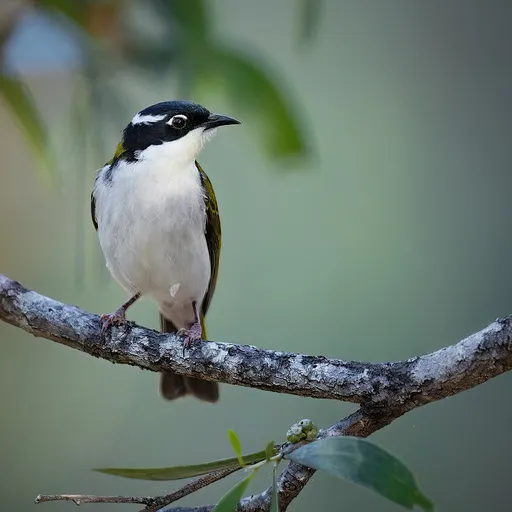
White-throated Honeyeater
Melithreptus albogularis
Least Concern
Overview
The white-throated honeyeater (Melithreptus albogularis) is a bird in the honeyeater family native to New Guinea and eastern and northern Australia. It is a small, black-headed species that forages primarily in the foliage of open, dry forests and savannahs. The species is classified as Least Concern on the IUCN Red List.
Identification
- 11.5 to 14.5 cm in length with olive-green upperparts and white underparts.
- Distinctive black head featuring a white or pale blue patch of bare skin over the eye and a white stripe across the nape.
- Black bill, red-brown eyes, and purple-brown legs.
- Subspecies inopinatus is larger and has a duller olive back compared to albogularis.
Habitat
Found in more open, dry sclerophyll forests and savannahs across New Guinea, eastern and northern Australia. The species is divided into two subspecies: albogularis found in northwestern Australia, the Northern Territory, and Cape York, and inopinatus found in central and southeastern Queensland.
Diet
Forages for insects in foliage or canopy rather than on bark or branches. The species is known to congregate in larger flocks while foraging.
Did you know?
Genetic research published in 2010 revealed that the Carpentarian Barrier fostered a split between lineages east and west of it in the Pliocene, between 2.4 and 5.2 million years ago. The current subspecies division, however, corresponds to a more recent split between 1 and 2.8 million years ago in northeastern Queensland.
Sources
- Wikipedia · CC BY-SA 4.0
- Wikidata · CC0 1.0