
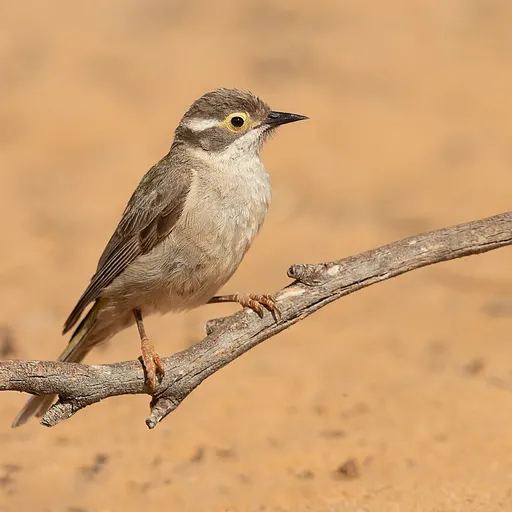
Brown-headed Honeyeater
Melithreptus brevirostris
Least Concern
Overview
The brown-headed honeyeater (Melithreptus brevirostris) is a small passerine bird in the family Meliphagidae endemic to Australia. Its species name derives from the Latin terms for 'short' and 'beak', and it is currently classified as Least Concern on the IUCN Red List.
Identification
- A small bird ranging from 13 to 15 cm in length, with olive-brown upperparts, buff underparts, and a brown head, nape, and throat.
- Features a cream or orange patch of bare skin over the eye and a dull white crescent-shaped patch on the nape.
- Possesses orange legs and feet.
- Produces a scratchy 'chwik-chwik-chwik' call.
Habitat
This species inhabits temperate forests and Mediterranean-type shrubby vegetation across central-southern Queensland, central and eastern New South Wales, Victoria, and eastern South Australia. It is also found in the Flinders Ranges, around the lower Murray River region, the Eyre Peninsula, and in a subspecies in south-western Western Australia.
Diet
Insects form the bulk of its diet, and it forages by probing in the bark of trunks and branches of trees, similar to its close relatives the black-chinned and strong-billed honeyeaters.
Did you know?
The race magnirostris from Kangaroo Island has a noticeably larger bill than other subspecies.
Sources
- Wikipedia · CC BY-SA 4.0
- Wikidata · CC0 1.0