
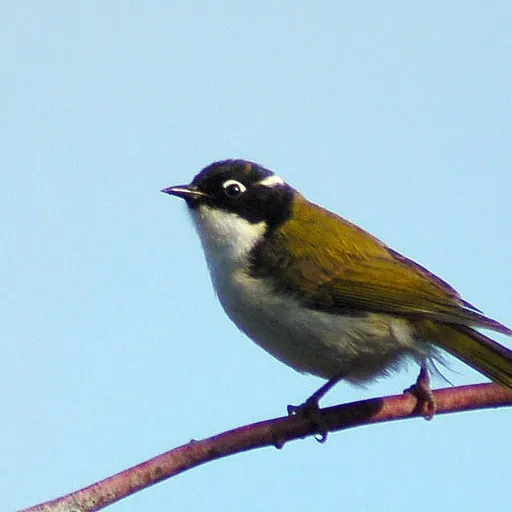
Gilbert's Honeyeater
Melithreptus chloropsis
Least Concern
Overview
Gilbert's honeyeater, also known as the Swan River honeyeater, is a passerine bird of the family Meliphagidae native to southwestern Australia. Classified as Least Concern by the IUCN, this mid-sized species was formerly treated as a subspecies of the white-naped honeyeater before being recognised as distinct in 2010.
Identification
- Plumage: Olive-green upperparts and white underparts, with a black head, nape, and throat. Distinctive white patch over the eye and a thinner white crescent on the nape compared to similar species.
- Eyes and Bill: Dull red eyes and a brownish-black bill that is slightly longer than that of the white-naped honeyeater.
- Similarities: Identical to the white-naped honeyeater except for the red eyes (white-naped has pale-green to off-white eye rings) and larger overall size.
- Voice: Emits a harsh, grating call and a continuously uttered, single-noted tsip.
Habitat
Found in the southwest corner of Western Australia, ranging from Moora in the north to Stokes Inlet on the coast. The species inhabits dry sclerophyll forests and woodlands dominated by jarrah, karri, marri, tuart, flooded gum, or wandoo. It is generally sedentary but has become less common on the Swan Coastal Plain, with populations having vanished from some areas such as Kellerberrin.
Diet
Primarily forages in the foliage and flowers of the canopy of tall eucalypts, though it occasionally ventures into understory plants and tree trunks. Its diet consists mainly of arthropods, particularly insects, as well as nectar, manna, honeydew, and lerp.
Did you know?
The species' scientific name, chloropsis, is derived from the Ancient Greek terms chloros meaning 'green-yellow' and opsis meaning 'eye'. This refers to the greenish-yellow area around the eye in the similar white-naped honeyeater, distinguishing it from Gilbert's honeyeater, which possesses dull red eyes.
Sources
- Wikipedia · CC BY-SA 4.0
- Wikidata · CC0 1.0