
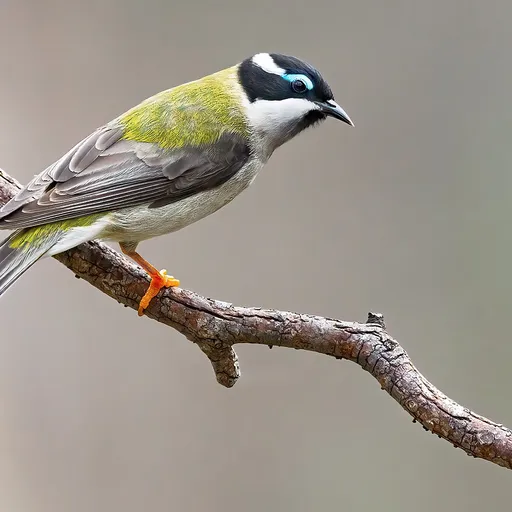
Black-chinned Honeyeater
Melithreptus gularis
Least Concern
Overview
The black-chinned honeyeater is a mid-sized passerine bird endemic to Australia. It belongs to the honeyeater family and is currently classified as Least Concern on the IUCN Red List.
Identification
- Olive-brown upperparts and buff underparts with a distinct black head, nape, and throat.
- Features a bluish patch of bare skin over the eye and a white crescent-shaped patch on the nape.
- Mid-sized bird measuring 14 to 16 cm in length with orange legs and feet.
- Vocalises with a scratchy 'creep-creep-creep' call alongside a more musical song.
Habitat
Found across northern Australia, extending into central and eastern Queensland, central New South Wales, and parts of Victoria and South Australia. It inhabits open woodland and dry sclerophyll forest, often near watercourses, and is absent from the savanna on the western edge of the Einasleigh Uplands.
Diet
Insects form the bulk of its diet. It forages by probing in the bark of trunks and branches of trees, similar to its close relatives the brown-headed and strong-billed honeyeaters.
Did you know?
The black-chinned honeyeater was described by John Gould in 1837 after receiving four skins from Frederick George Waterhouse of the South Australian Museum, who specifically wrote to Gould of their beauty. Although Richard Schodde united the golden-backed honeyeater into a single species in 1975, genetic data published in 2010 revealed that the two subspecies diverged between 0.3 and 1.2 million years ago, separated by the Carpentarian Barrier.
Sources
- Wikipedia · CC BY-SA 4.0
- Wikidata · CC0 1.0