
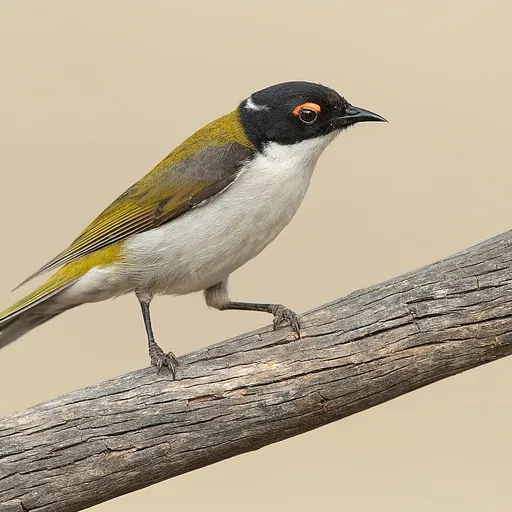
White-naped Honeyeater
Melithreptus lunatus
Least Concern
Overview
The white-naped honeyeater (Melithreptus lunatus) is a passerine bird of the honeyeater family native to eastern Australia. It is one of several similar species of black-headed honeyeaters in the genus Melithreptus and is currently classified as Least Concern on the IUCN Red List.
Identification
- Mid-sized passerine, 13–15 cm long, thinner than similar species
- Olive-green upperparts, white underparts, black head, nape, and throat
- Red patch over the eye and a white, crescent-shaped patch on the nape
- Call described as a 'mjerp mjerp'
- Juveniles have brownish crowns and an orange bill base
Habitat
Found in eucalypt forest and dry sclerophyll eucalypt woodland in eastern Australia. Gilbert's honeyeater, found in southwest Western Australia, has been classified as a distinct species.
Diet
Primarily feeds on nectar from a variety of flowers, supplemented by insects and various other invertebrates.
Did you know?
The species' scientific name is derived from the Latin word luna, meaning 'moon', which refers to the crescent-shaped white marking on its nape.
Sources
- Wikipedia · CC BY-SA 4.0
- Wikidata · CC0 1.0