
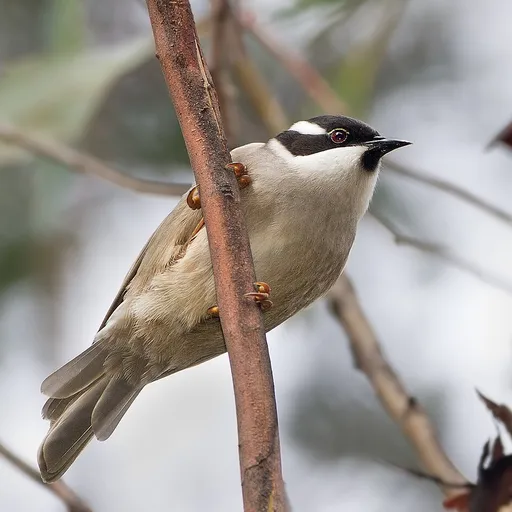
Strong-billed Honeyeater
Melithreptus validirostris
Vulnerable
Overview
The strong-billed honeyeater (Melithreptus validirostris) is a mid-sized bird species endemic to Tasmania, Australia. Classified as Vulnerable by the IUCN, it is one of two species in the genus Melithreptus and belongs to the family Meliphagidae.
Identification
- Mid-sized honeyeater measuring 16.5–17.5 cm in length.
- Olive-brown upperparts, pale grey-brown underparts, with a black head, nape, and throat.
- Distinctive pale blue to off-white patch over the eye and a white crescent on the nape.
- Loud call described as a cheep cheep or a churring.
Habitat
Found exclusively in Tasmania, the species inhabits mature temperate forests characterised by large trees such as Eucalyptus regnans and E. delegatensis.
Diet
The diet consists principally of insects and invertebrates foraged on tree trunks, supplemented by nectar and fallen fruit. Although widespread in Tasmania, it rarely overlaps in foraging sites with the black-headed honeyeater.
Did you know?
The specific name validirostris is derived from Latin words meaning 'strong bill', referring to the bird's robust beak.
Sources
- Wikipedia · CC BY-SA 4.0
- Wikidata · CC0 1.0