
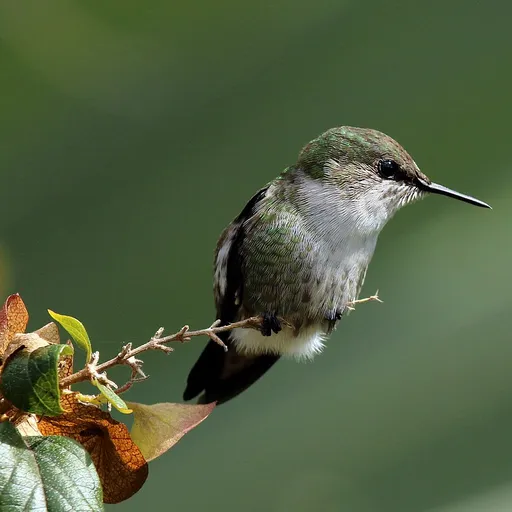
Vervain Hummingbird
Mellisuga minima
Least Concern
Overview
The vervain hummingbird (Mellisuga minima) is a species of hummingbird in the subfamily Trochilinae, often referred to as a bee hummingbird. It is found on the Caribbean islands of Hispaniola and Jamaica and is classified as Least Concern by the IUCN.
Identification
- Approximately 6 cm (2.4 in) in length, including a 1 cm (0.39 in) bill, and weighing between 2 and 2.4 g.
- Males possess a dull metallic green upperside, pale grey spotted underparts, and a short, straight, dull black bill.
- Males uniquely lack iridescent feathering and have a slightly forked black tail, whereas females have rounded tails with white-tipped feathers.
- Males are highly vocal, producing a complex song from exposed perches that varies by subspecies.
Habitat
The species inhabits a wide range of landscapes throughout its range, including gallery forest, dry forest, desert scrub-shrub, gardens, and urban areas, while avoiding the interior of dense montane forest. It occurs at elevations ranging from sea level to at least 1,600 m (5,200 ft).
Diet
The vervain hummingbird forages for nectar from a wide variety of flowering plants, typically selecting small, low-yield flowers while cocking its tail up. It supplements its diet by capturing small insects through hawking from a perch or hovering in patches of flying insects.
Did you know?
The clutch consists of two eggs that are among the smallest of all birds, with an average length of 1 cm (0.39 in) and a weight of just 0.38 g (0.013 oz).
Sources
- Wikipedia · CC BY-SA 4.0
- Wikidata · CC0 1.0