
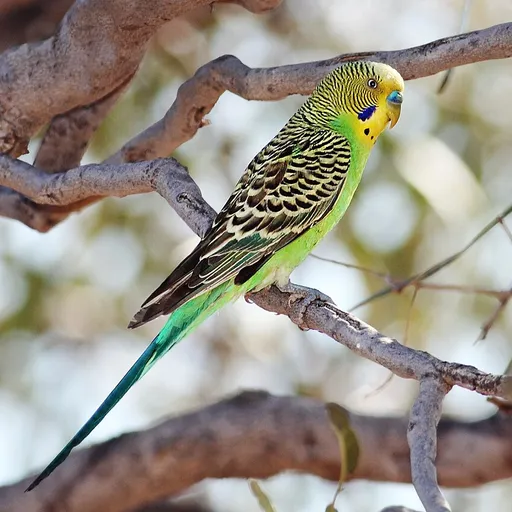
Budgerigar
Melopsittacus undulatus
Least Concern
Listen
XC707108 · Sonothèque ADVL · Carolles, Manche, Normandie, France · CC0 1.0
Overview
The budgerigar (Melopsittacus undulatus), also known as the common parakeet, is a small, long-tailed, seed-eating parrot native to Australia. It is a nomadic flock parakeet that has been bred in captivity for centuries, resulting in numerous colour mutations.
Identification
- Plumage: Naturally green and yellow with black, scalloped markings on the nape, back, and wings; captive birds may display blues, whites, greys, and crests.
- Size: Wild birds average 18 cm in length with a 30 cm wingspan, noticeably smaller than captive individuals.
- Markings: Yellow forehead and face in adults; small iridescent blue-violet cheek patches and three black spots on each side of the throat.
- Cere: Males typically have a lavender or blue cere, while females have a pale brownish or white cere that turns brown during breeding.
Habitat
Found wild throughout the drier parts of Australia, primarily in scrublands, open woodlands, and grasslands. The species is nomadic, moving flocks as environmental conditions and food or water availability change. Drought may drive flocks into more wooded habitat or coastal areas.
Diet
Budgerigars feed primarily on the seeds of spinifex, grass, and sometimes ripening wheat. They also opportunistically depredate growing cereal crops and lawn grass seeds. Due to the low water content of their diet, they rely on the availability of fresh water.
Did you know?
Budgerigars have tetrachromatic colour vision, which allows them to see ultraviolet light that brightens their feathers to attract mates. Their throat spots reflect UV light and can be used to distinguish individual birds.
Sources
- Wikipedia · CC BY-SA 4.0
- Wikidata · CC0 1.0