
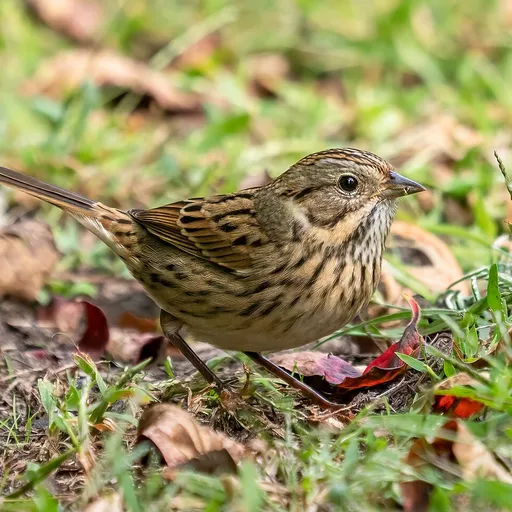
Lincoln's Sparrow
Melospiza lincolnii
Least Concern
Overview
Lincoln's sparrow (Melospiza lincolnii) is a small, secretive passerine bird native to North America that often remains hidden beneath thick ground cover. It belongs to the genus Melospiza and is classified as Least Concern on the IUCN Red List. Despite its small size and elusive nature, it is recognised by its distinctive vocalisations.
Identification
- Dark-streaked olive-brown upperparts, light brown streaked breast, white belly, and throat.
- Brown cap with a central grey stripe, olive-brown wings, narrow tail, and a grey face with brown cheeks and a buffy mustache.
- Similar in appearance to the song sparrow but smaller, trimmer, and with finer breast streaks.
- Males sing a sweet, wrenlike, gurgling song that starts with rapid high-pitched notes, transitions into a rising and dropping trill, and includes a distinct hoarse 'zrrr-zrrr-zrrr' sequence for mating and territorial disputes.
Habitat
Breeding habitats include subalpine and montane zones across Canada, Alaska, and the northeastern and western United States, primarily in wet thickets, shrubby bogs, and moss-dominated areas. They also inhabit mixed deciduous groves, shrub-willow patches, and black spruce-tamarack bogs at lower elevations. Wintering ranges extend from the southern United States to Mexico and northern Central America, utilising tropical evergreen and deciduous forests, pine-oak woodlands, and arid scrublands.
Diet
During winter, they feed mainly on small seeds from weeds and grasses, occasionally consuming terrestrial vertebrates when available. In the breeding season, their diet consists largely of arthropods such as insect larvae, ants, spiders, beetles, flies, moths, caterpillars, and mayflies. Adults typically forage on the ground in dense vegetation and catch prey with their bills, swallowing it whole.
Did you know?
Male bill shape is correlated with the quality of their songs, with decreasing quality as the ratio of bill height to bill width decreases, which affects reproductive success. Males hatching later in the breeding season tend to develop less suitable bill shapes, resulting in reduced female mating preferences.
Sources
- Wikipedia · CC BY-SA 4.0
- Wikidata · CC0 1.0