
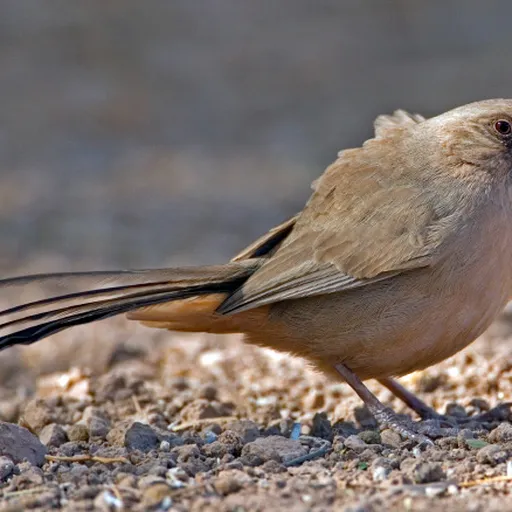
Abert's Towhee
Melozone aberti
Least Concern
Overview
Melozone aberti is a bird of the family Passerellidae, native to a small range in southwestern North America, nearly endemic to Arizona but also found in parts of California, Nevada, Utah, New Mexico, and Sonora, Mexico. Despite its limited range, it is classified as a species of Least Concern on the IUCN Red List.
Identification
- Size: The longest species in the New World sparrow family, measuring 21 to 25 cm (8.3 to 9.8 in) in length, with a notably long tail of 10 to 12 cm (3.9 to 4.7 in).
- Plumage: Overall brown coloration with distinct, dark faces that help distinguish it from the similar California towhee.
- Bill: Short and small, measuring 1.5 to 1.6 cm (0.59 to 0.63 in) in length.
Habitat
This bird inhabits brushy riparian areas within the Lower Sonoran desert zone, generally along the lower Colorado River and Gila River watersheds. It prefers to remain well-hidden under bushes but has successfully colonised suburban environments in the Phoenix metropolitan area and expanded its range along the Santa Cruz River and in Oak Creek Canyon near Sedona.
Diet
Abert's towhees forage on the ground among dense brush, primarily consuming seeds while also incorporating insects into their diet. They scratch at the ground in a manner similar to quail and will sometimes dig up and eat grubs, and can be attracted to feeders by cracked corn provided on the ground.
Did you know?
Despite being a desert-dwelling bird, it has successfully adapted to urban environments, where it may be easily seen on the campus of Arizona State University in the Phoenix metropolitan area.
Sources
- Wikipedia · CC BY-SA 4.0
- Wikidata · CC0 1.0