
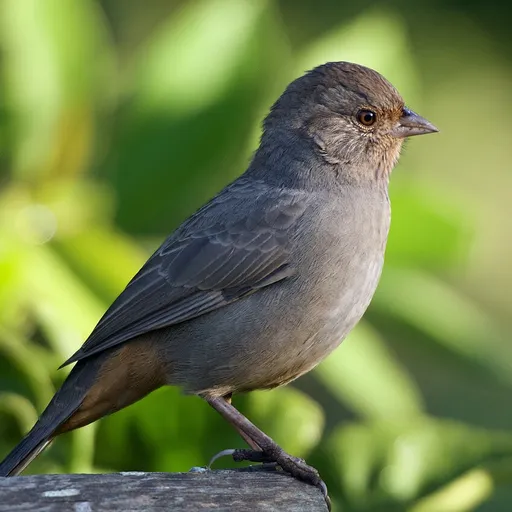
California Towhee
Melozone crissalis
Least Concern
Overview
The California towhee (Melozone crissalis) is a non-migratory passerine native to the coastal regions of western Oregon and California in the United States, as well as Baja California in Mexico. It is classified as a species of Least Concern on the IUCN Red List, with a global breeding population estimated at around nine million birds.
Identification
- Dull, matte brown plumage with light rust undertail coverts and buff or rust-colored streaks on the throat.
- Appears as a large, plain sparrow with short, rounded wings and a noticeably long tail.
- Features a thick beak used for cracking seeds.
- The call is a single note described variously as 'seet', 'tsip', or 'cheenk', while the song is a long repeating series ended with a trill.
Habitat
This species inhabits brush, chaparral, open woodlands, and areas along streams adjacent to desert slopes, extending from southern Oregon to Baja California. It has successfully adapted to human environments, including rural and suburban parks, gardens, and backyards with appropriate shrubbery.
Diet
The bird forages on the ground or in low scrub, consuming a variety of seeds, grasses, herbs, and insects such as grasshoppers, beetles, snails, and spiders. It uses a 'double-scratch' maneuver to look beneath leaves by lunging forward and hopping backwards, and it will visit feeders where it often eats millet that other birds disdain.
Did you know?
A subspecies of the California towhee in the Inyo Mountains of Eastern California was down to approximately 175 breeding birds in the early 1980s due to habitat displacement by agricultural projects. Conservation efforts by the Bureau of Land Management, including restrictions on mining and livestock agriculture, have helped the population recover to over 700 birds.
Sources
- Wikipedia · CC BY-SA 4.0
- Wikidata · CC0 1.0