
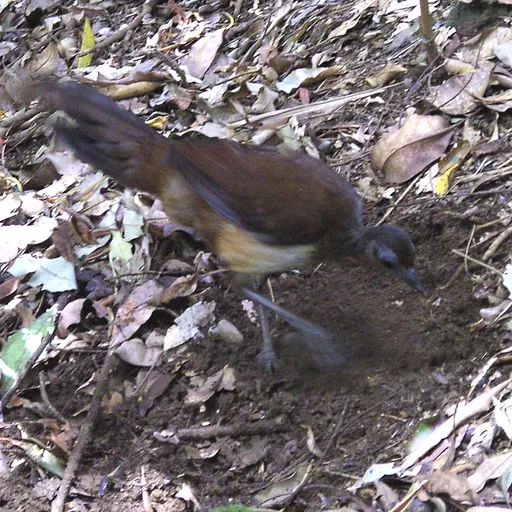
Albert's Lyrebird
Menura alberti
Least Concern
Overview
Menura alberti, also known as the northern lyrebird, is a timid, pheasant-sized songbird endemic to the subtropical rainforests of Australia's state border between New South Wales and Queensland. It is the rarer of the two lyrebird species and lacks the elegant lyre-shaped tail feathers found in its counterpart, the superb lyrebird.
Identification
- Females measure approximately 75 cm in length, while males reach about 90 cm, with a wingspan of 76–79 cm and a weight of around 930 g.
- Plumage is chestnut-brown with a rufous undertail, rump, and throat; the bill is black with dark brown or black irises surrounded by a broad blue-grey ring.
- Males possess a spectacular tail consisting of central ribbon-like plumes, six pairs of filmy filamentary feathers, and a broad webbed outermost pair, which they carry in an upward-curving train.
- Both sexes produce powerful, flexible songs that include mimicry of species such as the green catbird, satin bowerbird, and rosellas, often creating sounds ranging from deep and resonant to high, thin squeaks.
Habitat
This species inhabits rainforest with a dense understorey of vines and shrubs, or wet sclerophyll forest with dense rainforest plants, preferring areas with steep, moist valleys protected from wildfire. Its range is restricted to small areas of mountain ranges in far south-east Queensland and far north-east New South Wales, having declined significantly due to habitat clearing and now largely occupying reserves and higher altitudes.
Diet
Albert's lyrebird feeds mainly on insects, including beetles and their larvae, and other soil-dwelling invertebrates. It typically forages on the ground in deep moist leaf litter and fallen logs, scratching among debris, turning over leaves, and digging into soil, though it occasionally forages in epiphytic ferns.
Did you know?
The male's courtship display involves raising his tail to arch forwards above his head before gradually lowering and shimmering it to envelop the bird in a veil of silvery, bushy filaments. This display is performed on a flat piece of ground from which all debris has been meticulously raked, distinguishing it from the mound of debris used by the superb lyrebird.
Sources
- Wikipedia · CC BY-SA 4.0
- Wikidata · CC0 1.0