
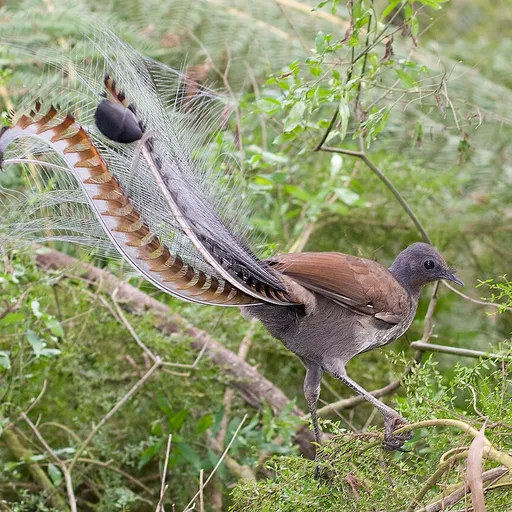
Superb Lyrebird
Menura novaehollandiae
Least Concern
Listen
XC442769 · James Ray · Faulconbridge, Blue Mountains City Council, New South Wales, Australia · CC BY-SA 4.0
Overview
The superb lyrebird (Menura novaehollandiae) is a large Australian passerine songbird and one of two species in the family Menuridae. It is one of the world's largest songbirds, renowned for its elaborate tail feathers, courtship displays, and exceptional vocal mimicry abilities.
Identification
- Large, pheasant-sized terrestrial bird ranging from 860 mm to 1 m in length.
- Plumage is mainly dark brown on the upper body with greyish-brown underparts and red-tinged flight feathers.
- Males possess an elaborate tail up to 70 cm long, featuring two broad, S-shaped outer feathers called 'lyrates' and twelve silvery filamentaries.
- Females have a less ornate tail with shorter lyrates and plain broad feathers.
- Vocalisations consist of 70–80% accurate imitations of other species, including birds, marsupials, and anthropogenic sounds like car alarms.
Habitat
Endemic to Australia, this species inhabits forests in the southeast of the country, ranging from southern Victoria to southeastern Queensland. Preferred habitats include wet forests and rainforests with an open ground layer of moist leaf litter shaded by vegetation, though they are also found in subtropical and temperate rainforests and wet and dry sclerophyll forests.
Diet
The diet consists primarily of invertebrates such as earthworms and insects found on the forest floor, with evidence that they also consume fungi. Foraging involves vigorous scratching in upper soil layers to disturb topsoil and leaf litter, most often occurring in damp rainforest vegetation where the bottom vegetation strata is open and low in complexity.
Did you know?
Superb lyrebirds act as significant ecosystem engineers, moving and burying up to 200 tonnes per hectare of leaf litter and soil annually, which hastens decomposition and reduces the fuel available for forest fires.
Sources
- Wikipedia · CC BY-SA 4.0
- Wikidata · CC0 1.0