
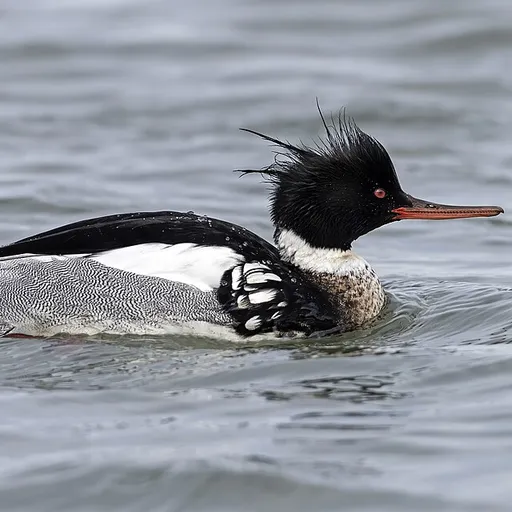
Red-breasted Merganser
Mergus serrator
Least Concern
Listen
XC1092100 · Sonothèque ADVL · Granville, Manche, Normandy, France · CC0 1.0
Overview
The red-breasted merganser (Mergus serrator) is a duck species native to much of the temperate to subarctic Northern Hemisphere. It is the most frequent species in the genus Mergus to regularly frequent saltwater, migrating from freshwater breeding sites to coastal wintering areas. The species is currently listed as Least Concern by the IUCN, though it faces threats such as habitat loss and toxin exposure.
Identification
- Size: Adults measure 51–64 cm in length with a wingspan of 66–74 cm; males average 950–1,350 g and females 800–1,100 g.
- Plumage: Breeding males have a dark head with a green sheen, a white neck, a rusty breast, a black back, and white underparts; females and juveniles have rusty heads and greyish-brown bodies.
- Bill: Long, thin, and red with distinctive serrated edges that resemble a saw.
- Voice: Females produce a rasping 'prrak prrak' during courtship and a harsh 'gruk' in flight, while males emit a cat-like 'meow'; otherwise, the species is largely silent.
Habitat
Breeding habitats consist of freshwater lakes and rivers across northern North America, Greenland, Europe, and the Palearctic. The species is mostly migratory, with northern breeders wintering in coastal waters, though populations in parts of northwestern Europe, such as Iceland, Ireland, Britain, and Norway, are largely resident.
Diet
Red-breasted mergansers feed by diving and swimming underwater to pursue aquatic prey. They mainly eat small fish but also consume aquatic insects, worms, crustaceans, and amphibians.
Did you know?
Males perform a highly stereotypic metronomic courtship display that can last from mid-November to June, involving stretching, bending, and contracting their necks in synchrony to fan their crests while females watch to select a mate.
Sources
- Wikipedia · CC BY-SA 4.0
- Wikidata · CC0 1.0