
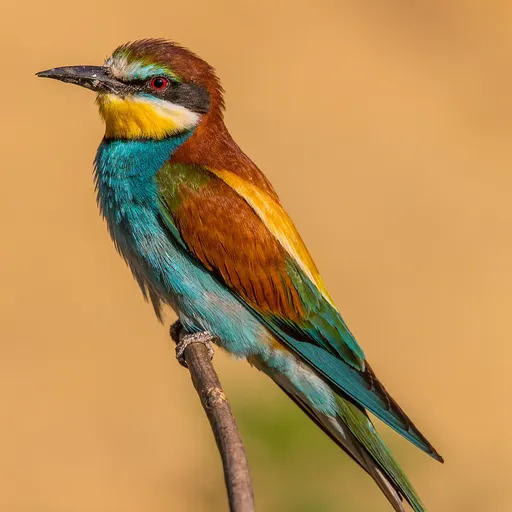
European Bee-eater
Merops apiaster
Least Concern
Listen
XC1133009 · Philippe_Grange · Arrondissement de Narbonne (near La Palme), Aude, Occitanie, France · CC0 1.0
Overview
The European bee-eater (Merops apiaster) is a richly coloured, slender bird in the family Meropidae with the largest range of any bee-eater species. It is strongly migratory, except for resident populations in southern Africa, and can occasionally occur as a spring overshoot in northern Europe.
Identification
- Slender body reaching 27–29 cm in length, including two elongated central tail feathers in breeding plumage.
- Brown and yellow upper parts, green wings, and a black beak.
- Females tend to have greener rather than gold feathers on the shoulders.
- Emits a distinctive, mellow, liquid and burry call described as 'prreee' or 'prruup'.
Habitat
Breeds in open country in warmer climates across southern and central Europe, northern and southern Africa, and western Asia. The species nests colonially in sandy banks, preferably near river shores, and winters in tropical Africa.
Diet
Predominantly eats insects, especially bees, wasps, and hornets, catching them in flight from open perches. Before consuming a bee, the bird removes the sting by repeatedly hitting the insect on a hard surface. Honey bees can constitute up to 82% of its diet in some regions.
Did you know?
European bee-eaters are frightened of falcons, a fact some apiarists exploit by using fake falcon scarecrows to protect hives from these insect-eaters.
Sources
- Wikipedia · CC BY-SA 4.0
- Wikidata · CC0 1.0