
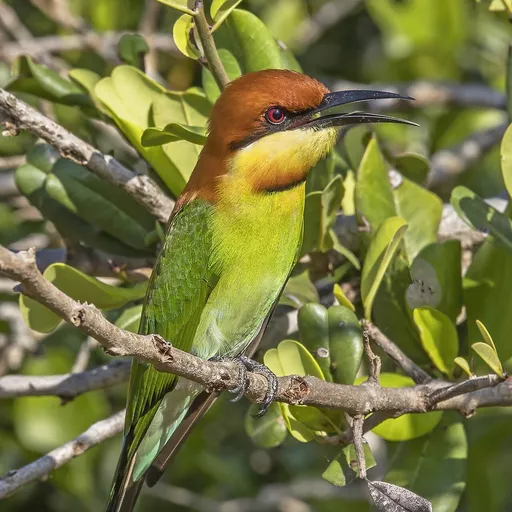
Chestnut-headed Bee-eater
Merops leschenaulti
Least Concern
Overview
The chestnut-headed bee-eater, also known as the bay-headed bee-eater, is a slender, richly coloured bird in the bee-eater family. It is classified as a species of Least Concern on the IUCN Red List.
Identification
- Measures 18–20 cm in length and weighs between 26–33 g.
- Predominantly green plumage with a rich chestnut crown, nape, and forehead.
- Features a yellow face and throat marked by a black eye stripe and a black pectoral band.
- Possesses a thin, curved black bill and lacks the elongated central tail feathers found in other relatives.
- Red irises and dusky black legs.
Habitat
This species breeds in sub-tropical open woodland, where it is most commonly found in highland areas. Its range covers the Indian subcontinent and adjoining regions, extending from India, Bangladesh, and Sri Lanka across Southeast Asia to Indonesia.
Diet
Primarily feeds on insects, particularly bees, wasps, and hornets, which are caught in the air during sorties from an open perch. It is gregarious, feeding and roosting communally, though instances of feeding on fish by flying over water have been recorded.
Did you know?
Although formally described in 1817 with a type locality of Java, this was an error as the species does not actually occur there; the locality was later corrected to Sri Lanka. The specific epithet honours Jean-Baptiste Leschenault de La Tour, who brought the specimen to France.
Sources
- Wikipedia · CC BY-SA 4.0
- Wikidata · CC0 1.0