
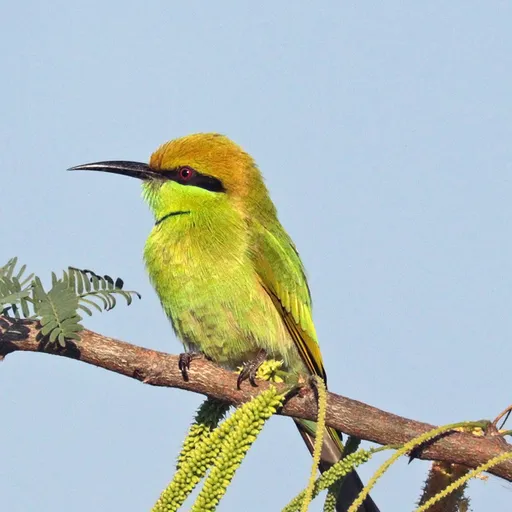
Asian Green Bee-eater
Merops orientalis
Least Concern
Listen
XC881011 · Jairam Vijayan · Payyavoor, Kannur, Kerala, India · CC BY-SA 4.0
Overview
The Asian green bee-eater, also known as the little green bee-eater, is a slender, richly coloured bird in the bee-eater family. It is widely distributed across Asia, ranging from coastal southern Iran east through the Indian subcontinent to Vietnam. The species is abundant and generally considered of Least Concern by the IUCN.
Identification
- 16–18 cm long with an additional 7 cm elongated central tail-feathers; bright green plumage tinged with blue on the chin and throat, and golden rufous on the crown and upper back.
- A fine black eyestripe and a slender black crescent on the upper breast, with a crimson iris, black bill, and dark grey legs.
- Flight feathers appear bronzed coppery-green above and coppery-orange below; a nasal trill 'tree-tree-tree-tree' is usually given in flight.
- Juveniles are paler, lack the long tail feathers and black throat crescent, and have a yellow-tinged throat.
Habitat
This species breeds in open country with bushes, grasslands, thin scrub, and forests, often well away from water. It inhabits plains up to 2,000 m in the Himalayas and is increasingly common in urban and sub-urban neighbourhoods. Populations are resident or make short-distance seasonal movements in response to rainfall and temperature.
Diet
They predominantly eat insects, especially bees, wasps, and ants, caught in the air from open perches such as fence wires. Before swallowing, they thrash prey on the perch to remove stings and break the exoskeleton. They have been observed taking crabs and regurgitating hard parts as pellets.
Did you know?
Studies suggest these birds can interpret the behaviour of human observers to predict if a person can see the nest entrance, a cognitive ability previously believed to be exclusive to primates. They also make use of human-made structures like television antennae to launch zig-zag flights to catch insects.
Sources
- Wikipedia · CC BY-SA 4.0
- Wikidata · CC0 1.0