
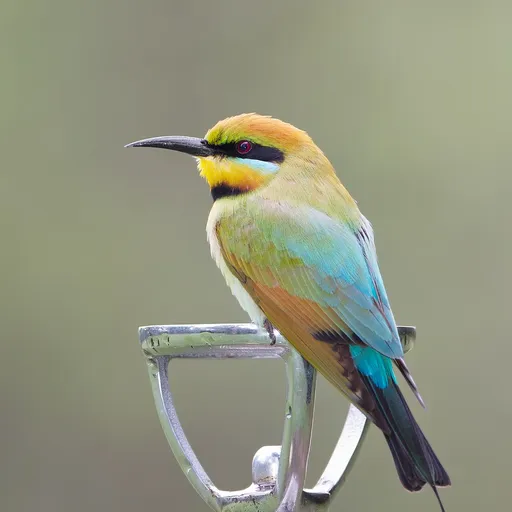
Rainbow Bee-eater
Merops ornatus
Least Concern
Overview
The rainbow bee-eater (Merops ornatus) is a brilliantly coloured bird and the only species of its kind in Australia. It is classified as Least Concern on the IUCN Red List, reflecting its common status, wide distribution, and stable population.
Identification
- Measures 23–28 cm in length, including elongated tail feathers, and weighs between 20–33 g.
- Features green upper back and wings, bright blue lower back and under-tail coverts, and rufous to copper undersides of the wings tipped with black.
- Displays a pale yellow-orange crown, breast, and throat, contrasted by a black crescent-shaped gorget and a blue-edged black stripe through the bright red eye.
- Males possess longer central tail streamers than females, while juveniles have duller plumage and lack these streamers.
Habitat
Found in forested areas across most of southern Australia during the summer, this species migrates north to northern Australia, New Guinea, and parts of Indonesia in winter. It occupies a variety of environments, including open woodlands, beaches, dunes, cliffs, mangroves, and farmlands, often frequenting parks and private gardens.
Diet
Primarily feeding on flying insects with a particular preference for bees, the bird spots prey from up to 45 metres away and swoops down to catch it with its long, slender bill. After knocking prey against a perch to subdue it, the bird rubs stingers against the wood to remove them before consumption, capable of eating several hundred bees daily.
Did you know?
Rainbow bee-eaters create their own ventilation system in narrow nest tunnels; the birds' bodies press so tightly against the walls that their movement acts like a piston, pumping in fresh air and pushing out stale air.
Sources
- Wikipedia · CC BY-SA 4.0
- Wikidata · CC0 1.0