
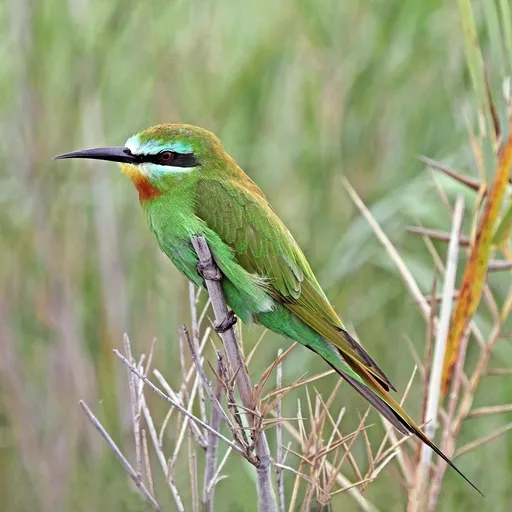
Blue-cheeked Bee-eater
Merops persicus
Least Concern
Overview
The blue-cheeked bee-eater (Merops persicus) is a richly coloured, slender bird that breeds in Northern Africa and the Middle East. It is generally strongly migratory, wintering in tropical Africa, though some populations remain resident in the Sahel.
Identification
- Predominantly green plumage with blue sides to the face, a black eye stripe, and a yellow and brown throat.
- Black beak and elongated central tail feathers that add approximately 7 cm to the body length of around 31 cm.
- Sexes are mostly alike, but the female has shorter tail-streamers.
- Call sounds 'flatter' and less 'fluty' than the European bee-eater.
Habitat
Breeds in sub-tropical semi-desert with sparse trees such as acacia, and winters in open woodland or grassland. Its range spans from eastern Turkey to Kazakhstan and India, with rare vagrants appearing in Italy and Greece.
Diet
Predominantly eats insects, especially bees, wasps, and hornets, caught in the air during sorties from open perches. It likely consumes more dragonflies than any other food item and also eats damselflies and lacewings.
Prefers telephone wires as a hunting perch if available.
Did you know?
Nests are dug as tunnels 1 to 3 metres long in sandy banks or cliffs, holding four to eight spherical white eggs, with the female alone incubating them at night.
Sources
- Wikipedia · CC BY-SA 4.0
- Wikidata · CC0 1.0