
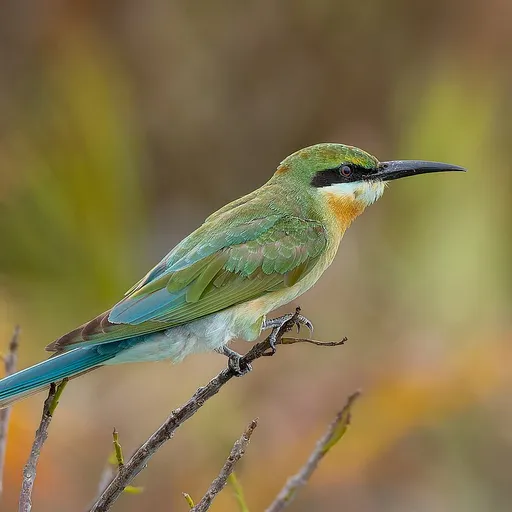
Blue-tailed Bee-eater
Merops philippinus
Least Concern
Listen
XC681276 · Vihansith Kulatunga · Andamkulam (near Trincomalee), Trincomalee, Eastern Province, Sri Lanka · CC BY-SA 4.0
Overview
The blue-tailed bee-eater (Merops philippinus) is a richly coloured, slender bird widely distributed across South and Southeast Asia. It is predominantly found in open habitats close to water, with many populations being strongly migratory and breeding colonially in small areas.
Identification
- Predominantly green plumage with a narrow blue face patch, black eye stripe, and yellow and brown throat.
- Blue rump and tail, with an elongated central tail feather extension of 7 cm in adults.
- Black beak and a body length of around 29 cm (excluding tail extensions), weighing 29–43 grams.
- Calls in flight with a rolling chirping whistling 'teerp'.
Habitat
Found across South and Southeast Asia, including India, Myanmar, and parts of Malaysia and Thailand, this species favours open habitats near water. Breeding occurs in river valleys and coastal areas, often in sandy or sandy clay loam banks where they nest by tunneling into the ground.
Diet
Primarily feeds on flying insects, especially bees, wasps, and hornets, which are caught in the air by sorties from an open perch. Captured insects are beaten on the perch to kill them and break the exoskeleton, a behaviour common in the order Coraciiformes.
Did you know?
Evidence suggests that blue-tailed bee-eaters may distribute the bee parasite Nosema ceranae across wide geographic ranges, as spores of the parasite have been found in their droppings.
Sources
- Wikipedia · CC BY-SA 4.0
- Wikidata · CC0 1.0