
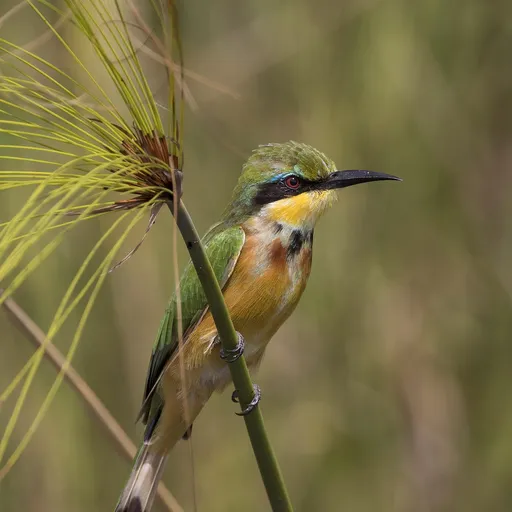
Little Bee-eater
Merops pusillus
Least Concern
Overview
The little bee-eater (Merops pusillus) is a small bird species in the Meropidae family found across Sub-Saharan Africa. It is the smallest of all African bee-eaters and is listed as Least Concern on the IUCN Red List.
Identification
- Plumage: Green upper parts and wings with a yellow throat, black gorget, and rich brown upper breast fading to buffish ochre on the belly.
- Size: Slender bird measuring 15–17 cm in length.
- Bill and Legs: Black bill and legs.
- Tail: Square shape with a slight fork or V-shape at the end.
- Vocalisation: Often silent, but may produce a soft "seep" call.
Habitat
Found throughout Sub-Saharan Africa, inhabiting savanna, bushveld, and marsh-like areas. They prefer open country with bushes, ideally near water, and exhibit limited seasonal migration dependent on rainfall patterns.
Diet
Predominantly feeds on insects, especially bees, wasps, and hornets, which are caught in the air from low perches of a metre or less in height. Before consumption, the bird removes the insect's stinger by repeatedly striking it against a hard surface.
Did you know?
Unlike most bee-eaters, this species nests solitarily by digging tunnels in sandy banks or utilising the entrances of aardvark dens.
Sources
- Wikipedia · CC BY-SA 4.0
- Wikidata · CC0 1.0