
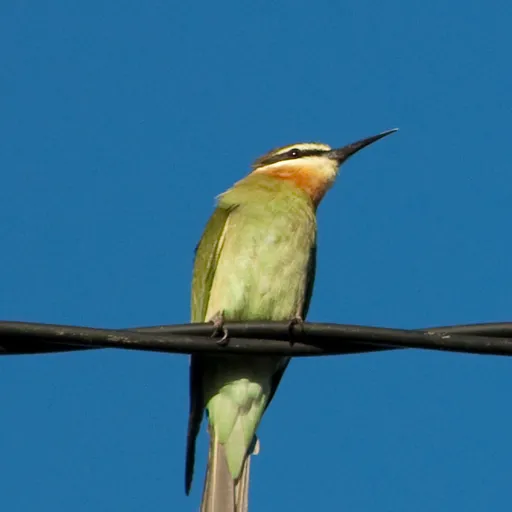
Olive Bee-eater
Merops superciliosus
Least Concern
Overview
The olive bee-eater, also known as the Madagascar bee-eater (Merops superciliosus), is a bird species native to the southern half of Africa. It is a common species with a wide distribution, ranging from East Africa and Madagascar to isolated populations in Angola.
Identification
- Bronzy-green plumage with an olive cap and white forehead, eyebrows, chin, and cheeks
- Blue rump and tail featuring black streamers that add approximately 7 cm to the body length
- Body length ranges from 23 to 26 cm (9.1 to 10.2 in)
Habitat
Found in grassland and coastal mountain forests of East Africa and Madagascar, with an isolated population in coastal Angola. It occurs across a broad range including countries such as Kenya, Tanzania, Mozambique, Angola, and Namibia.
Did you know?
Unlike most bee-eaters, the olive bee-eater does not practice cooperative breeding and exhibits a post-fledging dependence period of only about 19 days, which is typical of temperate zone passerines and roughly half that of most other members of the family Meropidae.
Sources
- Wikipedia · CC BY-SA 4.0
- Wikidata · CC0 1.0