
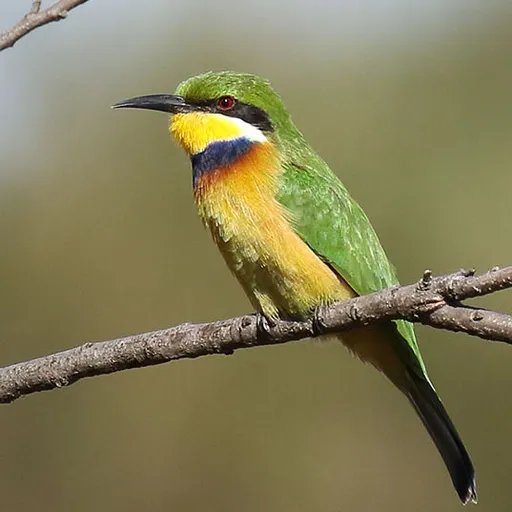
Blue-breasted Bee-eater
Merops variegatus
Least Concern
Overview
The blue-breasted bee-eater (Merops variegatus) is a central African bird belonging to the family Meropidae. It is a member of a group of visually similar birds whose diets are specialised in Hymenopterans.
Identification
- Measures 18–21 cm in length and weighs 20–26 g, featuring a relatively large head, short neck, and a long, curved, slim, sharp beak.
- Predominantly green plumage with a blue stripe over the black eye stripe, an orange-red iris, a white cheek, and a bright yellow throat.
- Displays a distinctive wide chest band consisting of a deep purple-blue gorget above a chestnut-coloured breastband.
- Perching song consists of short trills such as 'pip, tup-tup, and trrip', while the courtship song is expanded to 'turrp p'ti p'ti p'ti'.
Habitat
Found across central African countries including Angola, Zambia, Tanzania, Uganda, the Democratic Republic of the Congo, Nigeria, and Cameroon. The species inhabits open wet habitats ranging from reedy lake shores and papyrus beds to savanna grasslands bordering the Congo basin, as well as marshes and grassy hillsides.
Diet
The diet is specialised in Hymenopterans, particularly honey bee workers, flower bees, and Halictid bees, supplemented by flies, beetles, true bugs, grasshoppers, and butterflies. Foraging typically involves searching in pairs from perches such as bushes in savanna and forest edge habitats, where they wait for passing prey to give a horizontal chase and catch in the air. On rare occasions, they have been observed diving into shallow waters to catch small fish.
Did you know?
Although several bee-eater species are known for cooperative breeding, the blue-breasted bee-eater is a solitary monogamous breeder. The parents and their offspring remain highly social after the young fledge, sometimes staying together until the beginning of the next breeding season.
Sources
- Wikipedia · CC BY-SA 4.0
- Wikidata · CC0 1.0