
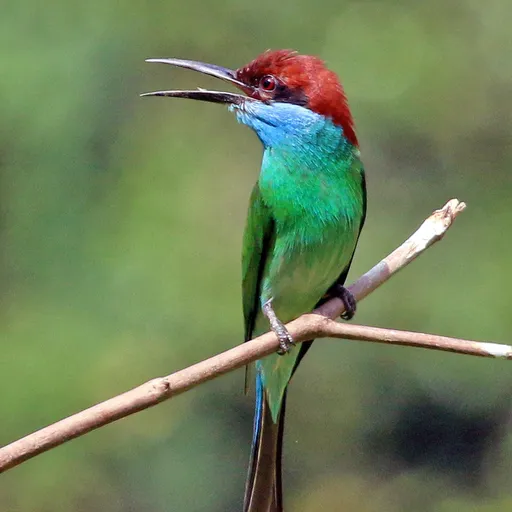
Blue-throated Bee-eater
Merops viridis
Least Concern
Overview
The blue-throated bee-eater (Merops viridis) is a medium-large, brightly coloured bird in the bee-eater family, native to much of southeast Asia. It thrives in a variety of habitats ranging from flat plains and farmland to mangrove forests, and is currently classified as a species of Least Concern due to its wide distribution and stable population.
Identification
- Adults display spectacular plumage with a red-brown crown and nape, dark green wings, a light green breast, and a signature blue throat.
- The bird measures around 21 cm in body length, plus an additional 9 cm of elongated central tail feathers, with a weight of approximately 34–41 grams.
- Juveniles are predominantly green with a dark green head and wings and light green breast, lacking the blue throat and long tail feathers until adulthood.
- All ages feature black eye stripes, and eyes range in colour from red to brown.
Habitat
Found from southeastern China to the Greater Sundas Islands, with the highest concentrations in Singapore, Malaysia, southern Cambodia, and southern Thailand. The species most commonly occupies low-altitude flat plains, including farmland, suburban gardens, riversides, and dunes, but can be found up to 1,600 m elevation. During the winter, some individuals move to forest canopies and saltwater channels within mangrove forests.
Diet
The species predominantly feeds on flying insects, particularly bees and wasps, though dragonflies make up a large percentage of its diet. It also consumes flies, beetles, and other bugs up to 42 mm in size. Foraging is most successful in sunny conditions, with no feeding activity observed during or immediately after rain.
Did you know?
Unlike most bee-eaters that dig nest burrows into near-vertical sand cliffs, the blue-throated bee-eater often excavates its nest burrows nearly horizontally into flat ground. Chicks also feature a sharp hook on their upper bill used for siblicide, which is shed as they develop contour feathers for protection.
Sources
- Wikipedia · CC BY-SA 4.0
- Wikidata · CC0 1.0