
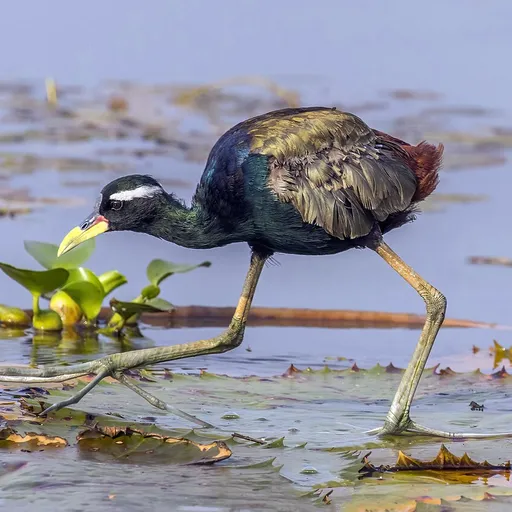
Bronze-winged Jacana
Metopidius indicus
Least Concern
Listen
XC928013 · craig wilson · Puri (near Kanchisasan), Central Division, Odisha, India · CC BY 4.0
Overview
The bronze-winged jacana (Metopidius indicus) is a large, rail-like wader and the sole species in the genus Metopidius. It is widely distributed across South and Southeast Asia, where it inhabits wetlands characterised by floating aquatic vegetation.
Identification
- A large, short-tailed bird appearing dark at a distance, with black head, neck, and breast contrasting sharply with a broad white supercilium running from over the eye to the back of the neck.
- Wings are bronzy brown with a green sheen, while the lower back and tail coverts are chestnut; the tail is stubby, reddish-brown, and features a black terminal band.
- Possesses a greenish-yellow bill with a red base to the upper mandible and a reddish-purple frontal lappet extending over the forehead.
- Legs and long, straight toes are greenish, and the hind toe bears an elongated nail that is longer than the toe itself.
- Call is a wheezy piping seek-seek-seek typically given in alarm.
Habitat
Found across the Indian subcontinent and Southeast Asia, mainly in low-elevation wetlands. The species is sedentary but may disperse seasonally in response to drought and rains, and is able to utilise wetlands covered in introduced weeds such as water hyacinth.
Diet
Forages on floating aquatic vegetation such as lilies, using its long feet and legs for balance. Feeds on plant material, insects, and other invertebrates picked from the floating vegetation or the water's surface.
Did you know?
Females are polyandrous and maintain a harem of males, while the males are solely responsible for incubating eggs and caring for the young. When threatened, male jacanas may carry their chicks to safety by sheltering them between their wings.
Sources
- Wikipedia · CC BY-SA 4.0
- Wikidata · CC0 1.0