
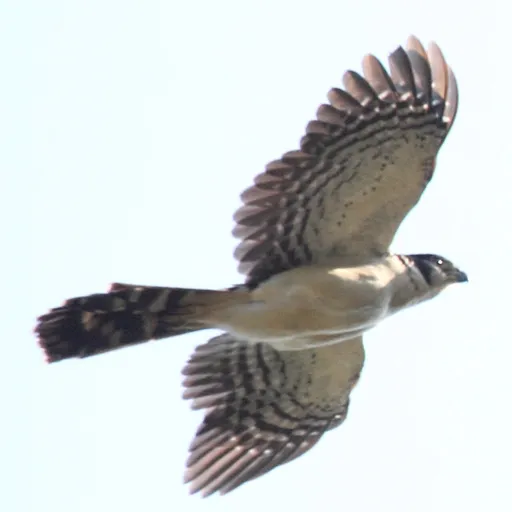
Collared Forest Falcon
Micrastur semitorquatus
Least Concern
Listen
XC463744 · Oliver Komar · Zamorano University campus, aquaculture area, San Antonio de Oriente, Francisco Morazan, Honduras · CC BY-SA 4.0
Overview
The collared forest falcon (Micrastur semitorquatus) is the largest member of the Micrastur genus and a common inhabitant of tropical rainforests across Latin America. As a secretive bird that hides within dense canopies, it is often recognised more by its distinctive calls than by sight.
Identification
- Dark-coloured back with a white neck and breast; pale and tawny morphs feature a light collar at the back of the neck that gives the species its name.
- Measures 46 to 58 cm in length with a wingspan of 72 to 86 cm, making it nearly the size of a peregrine falcon but with a longer tail and shorter wings.
- Produces a distinctive low, almost human-like 'ow' or 'ahr' call, typically lasting eight seconds and consisting of three or four notes.
Habitat
Found from sea level to 2,500 m elevation throughout Central and South America, spanning from Mexico south to Argentina. This species inhabits a wide variety of forested environments, including mangroves, tropical and rain forests, gallery forest, and tall second growth, generally preferring regions with relatively dense undergrowth.
Diet
This falcon conceals itself in the dense canopy before pursuing prey by flight, running, or hopping along the forest floor. Its diet includes a wide variety of animals such as mammals, birds, reptiles, and insects, with recorded prey sizes ranging from 20 g frogs to adult turkeys weighing 2.7 to 3.2 kg.
Did you know?
The collared forest falcon possesses a more pronounced facial disk, a trait typically seen in owls and harriers, which supports a specialised sense of hearing used to locate prey in dense forests.
Sources
- Wikipedia · CC BY-SA 4.0
- Wikidata · CC0 1.0