
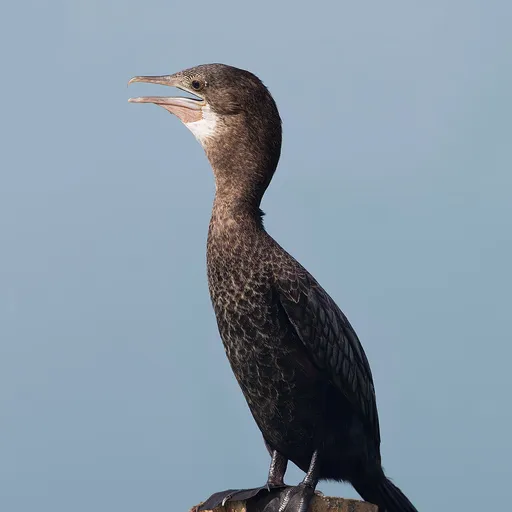
Little Cormorant
Microcarbo niger
Least Concern
Overview
The little cormorant (Microcarbo niger) is a member of the cormorant family of seabirds, slightly smaller than the Indian cormorant and lacking a peaked head. It is widely distributed across the Indian subcontinent and extends east to Java, where it is sometimes known as the Javanese cormorant.
Identification
- Approximately 50 cm in length, with a shorter beak than the Indian cormorant.
- Breeding adults exhibit glistening all-black plumage with white spots and filoplumes on the face, plus a short crest on the back of the head.
- Non-breeding birds and juveniles have brownish plumage, a more fleshy bill and gular skin, and a small white patch on the throat.
- Vocalisations include low roaring sounds, grunts, groans, and 'ah-ah-ah' or 'kok-kok-kok' calls.
Habitat
Found across India, Sri Lanka, Bangladesh, Pakistan, lowland Nepal, and parts of Myanmar, Thailand, Laos, Cambodia and Indonesia. It inhabits wetlands ranging from small village ponds to large lakes and sometimes tidal estuaries, but is absent from the Himalayas.
Diet
Primarily feeds on fish, swimming underwater and propelling itself with webbed feet to capture prey measuring 2–8 cm in length in water less than a metre deep. It often forages alone or in small loose groups and brings captured fish to the surface to swallow.
Did you know?
After emerging from the water, little cormorants hold their wings spread out and remain immobile, a behaviour linked to drying their wings after spending time submerged.
Sources
- Wikipedia · CC BY-SA 4.0
- Wikidata · CC0 1.0