
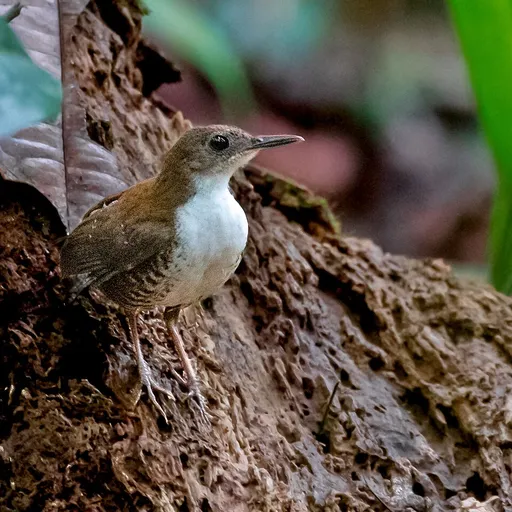
Southern Nightingale-Wren
Microcerculus marginatus
Least Concern
Listen
XC940745 · Carlos S. Rodrigues · PCH Estivadinho, Reserva do Cabaçal, State of Mato Grosso, Brazil · CC0 1.0
Overview
The southern nightingale-wren (Microcerculus marginatus), also known as the scaly-breasted wren, is a small bird belonging to the family Troglodytidae. It is currently assessed as being of Least Concern on the IUCN Red List and is found across a wide range in South and Central America.
Identification
- Measures 11 cm in length, with males weighing between 18.2 and 22 g and females between 17 and 18 g.
- Adults feature a dull grey-brown face, deep chocolate-brown upperparts with a reddish rump, and a very short dark tail.
- Underparts are white on the chin, chest, and upper belly with black scalloping on the chest sides, transitioning to dark chocolate on the lower flanks and belly.
- Song varies geographically, ranging from long complex series of short notes and whistles in Central America to clear, pure notes of varying pitch in Peru and Bolivia.
Habitat
This species inhabits the lower levels of dense humid tropical forest, ranging from sea level up to approximately 1,700 m in Costa Rica, 1,400 m in Colombia, and 1,800 m in Venezuela, with one record in Panama at 3,100 m. Its range spans central Costa Rica to Panama, parts of Colombia and Venezuela, and throughout Amazonia into Ecuador, Peru, Bolivia, and Brazil.
Diet
The bird forages alone on the ground and low in the understory, though little is known about its specific diet. It has been observed following army ant swarms in Central America, although it does not appear to do so routinely.
Did you know?
The species constructs nests from leaves at the end of burrows that were probably excavated by other bird species. Breeding activity appears to occur almost year-round in Panama, with active nests and fledged young reported throughout the year.
Sources
- Wikipedia · CC BY-SA 4.0
- Wikidata · CC0 1.0