
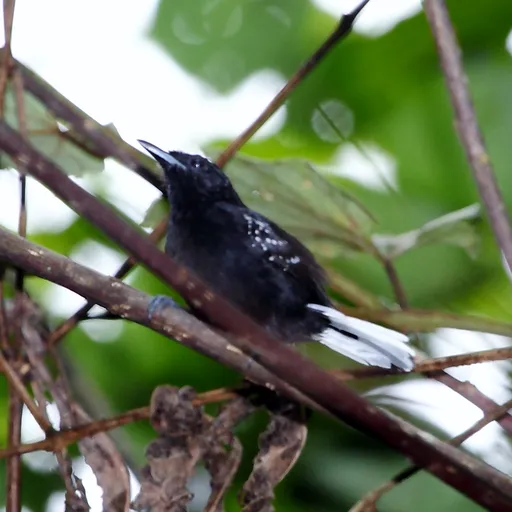
Dot-winged Antwren
Microrhopias quixensis
Least Concern
Listen
XC251129 · Niels Krabbe · Esmeraldas: Canandé, Ecuador · CC BY-SA 4.0
Overview
The dot-winged antwren, also known as the velvety antwren, is a passerine bird in the family Thamnophilidae. It is the sole member of the genus Microrhopias, which was erected by the English zoologist Philip Sclater in 1862.
Identification
- Males of the nominate subspecies are mostly black with a concealed white patch between the shoulders and large white tips on the wing coverts.
- Females have blackish gray heads and upperparts, a black throat, and rufous-chestnut underparts, with white wing and tail markings similar to the male.
- The species measures 10 to 12.5 cm in length and possesses a long graduated tail.
- Song varies by region but generally consists of an accelerating series of notes that shorten in length, such as 'tip-tip-Tip-Tip-Tip' or 'wee, tsee-tsi-tsi-tis-tu-tu'.
Habitat
The species inhabits tropical evergreen and secondary forests heavily vegetated with vine tangles, favouring edges and gaps rather than the interior of continuous forest. In some regions, such as southern Central America, it utilises shaded cacao and guava plantations, while in Ecuador and western Amazonia it often favours stands of bamboo and várzea forest. Its range extends from Mexico through Central America to South America, including parts of Bolivia, Brazil, Colombia, Ecuador, French Guiana, Guyana, Peru, and Suriname.
Diet
The dot-winged antwren feeds almost entirely on arthropods, foraging actively between 3 and 10 m above the ground by flutter-flying, hopping, and hitching along trunks and branches. It gleans prey from live vegetation, stems, and vines, often reaching, hanging, jumping, or hovering to capture insects. Although it rarely attends army ant swarms, it will take prey from near or on the ground when they occur.
Did you know?
The nest is a deep pouch made of partially decayed leaves, fastened together and to a branch fork with cobwebs and plant fibers. Both sexes contribute to nest building, incubation, and provisioning the nestlings.
Sources
- Wikipedia · CC BY-SA 4.0
- Wikidata · CC0 1.0