
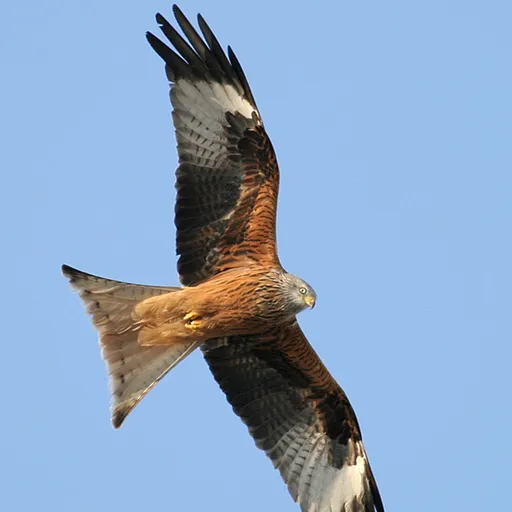
Red Kite
Milvus milvus
Listen
XC622807 · Nicolas Martinez · Rodersdorf, Dorneck, Solothurn, Switzerland · CC BY 4.0
Overview
The red kite (Milvus milvus) is an elegant bird of prey that currently breeds only in Europe, with former populations in West Asia and North Africa largely extirpated. An increasing number of northern birds now remain in their breeding regions year-round, whereas previously most wintered to the south and west.
Identification
- 60 to 70 cm long with a wingspan of 175–195 cm, featuring long wings held at a dihedral and a long forked tail.
- Rufous body, upper tail, and wing coverts with white primary flight feathers contrasting against black wing tips and dark secondaries.
- Sexes are similar in appearance aside from weight, but juveniles have a buff breast and belly, pale breast-streaks, and a less deeply forked tail with a dark subterminal band.
- Call is a thin piping sound, similar to but less mewling than the common buzzard.
Habitat
Red kites inhabit broadleaf woodlands, pastures, mixed farmland, valleys, and wetland edges at elevations up to at least 1,600 metres. They are native to the western Palearctic, with all currently known breeding pairs located in Europe, though vagrants have reached as far north as Finland and south to Israel, Libya, and the Gambia.
Diet
Generalist scavengers and predators, they feed mainly on carrion of large domestic animals, roadkill, and stranded fish, alongside small mammals, live birds, and invertebrates such as earthworms. In some parts of the United Kingdom, they are deliberately fed in domestic gardens, with chicken being the predominant meat provided.
Did you know?
In Marlow, Buckinghamshire, red kites were observed swooping down to steal sandwiches directly from people in a local park. Shakespeare referenced their habits by noting that 'when the kite builds, look to your lesser linen,' highlighting their historical tendency to steal washing hung out to dry.