
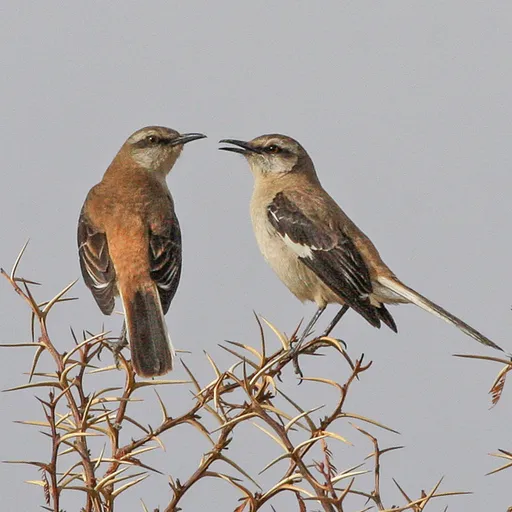
Brown-backed Mockingbird
Mimus dorsalis
Least Concern
Overview
The brown-backed mockingbird (Mimus dorsalis) is a species of bird in the family Mimidae, native to Argentina and Bolivia. It is classified as a species of Least Concern by the IUCN, as it appears to be common in suitable habitat despite being a relatively un-studied species.
Identification
- Adults measure 21 to 25.5 cm in length and weigh between 52 and 65 g, with an average weight of 58.7 g.
- The plumage features chestnut-brown crown and upperparts, which are brightest on the rump, with darker streaks on the crown.
- The face displays a well-defined whitish supercilium, a black line through the eye, and dusky cheeks, while the underside is whitish with a buff tinge.
- The tail is mostly blackish, but the outer three to four feathers are white.
- The song is described as a series of repeated harsh notes and chuckles.
Habitat
This species inhabits arid landscapes such as brush, desert shrubs, and hedgerows, often near human habitation. Its range covers western and southern Bolivia, from the La Paz Department south, and extends into northwestern Argentina as far as Tucumán Province. It typically occurs between 2,300 and 3,500 m in elevation but can range from 1,700 m to 4,200 m.
Diet
The brown-backed mockingbird forages mostly on the ground. Specific details regarding its diet and feeding behaviour have not yet been published.
Did you know?
The species is monotypic, meaning it has no recognised subspecies, and is a sister species to the white-banded mockingbird.
Sources
- Wikipedia · CC BY-SA 4.0
- Wikidata · CC0 1.0