
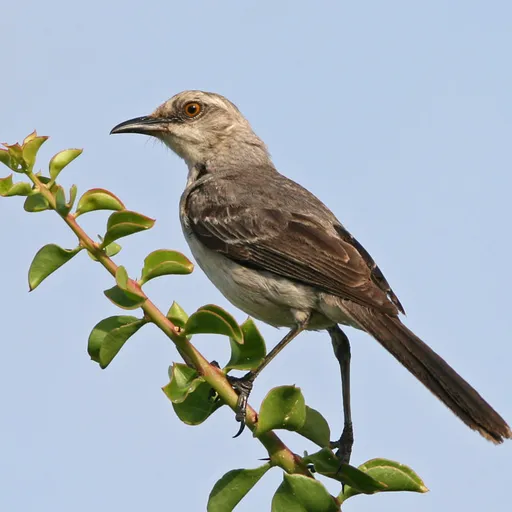
Tropical Mockingbird
Mimus gilvus
Least Concern
Listen
XC912250 · JUAN ANTONIO ALONSO DE JUAN · Pacho, Cundinamarca, Colombia · CC BY 4.0
Overview
The tropical mockingbird (Mimus gilvus) is a resident breeding bird found from southern Mexico to northern and eastern South America, as well as in the Lesser Antilles and other Caribbean islands. It is classified as Least Concern by the IUCN, though its range has contracted in southeastern Brazil due to habitat loss and illegal trapping.
Identification
- Adults measure 23 to 25.5 cm in length and feature a gray head and upper body, an off-white underbelly, and blackish wings with two white bars.
- They possess a long dark tail with white feather tips, a slim black bill with a slight downward curve, and long dark legs.
- The nominate subspecies displays a whitish supercilium and a dark stripe through the eye, while juveniles appear browner with dusky streaks on the chest and flanks.
- The song is a varied and long-continued sequence of diverse mellow to harsh notes and trills with considerable repetition, often heard through the night.
Habitat
The species is common in most open habitats, including scrublands, savannas, parks, and farmlands, and is frequently found near human habitation. It avoids closed forests and mangroves, typically occupying lowlands to middle elevations up to 2,500 m, though it can reach 3,100 m in northern Ecuador.
Diet
Omnivorous, the tropical mockingbird forages on the ground or low in vegetation and captures flying insects such as swarming termites. Its diet consists of arthropods like spiders and beetles, seeds, small fruits, larger cultivated fruits such as mangoes and sapodillas, lizards, bird and lizard eggs, and human food from feeders or directly.
Did you know?
Although it belongs to the mockingbird family, this species apparently rarely mimics other species. The El Salvador, Nicaragua, Costa Rica, and Panama populations of the M. g. tolimensis subspecies are descendants of escaped cage birds imported from Colombia.
Sources
- Wikipedia · CC BY-SA 4.0
- Wikidata · CC0 1.0