
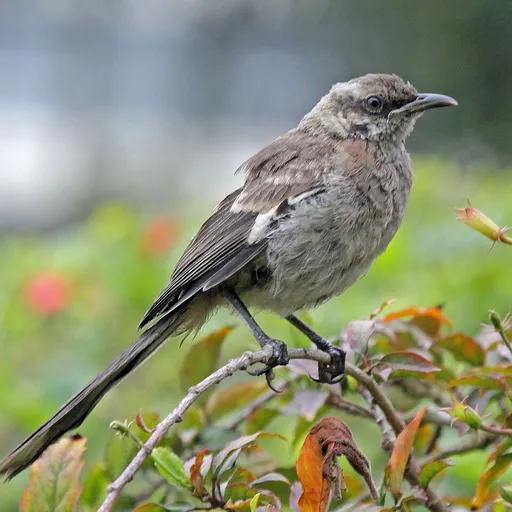
Long-tailed Mockingbird
Mimus longicaudatus
Least Concern
Listen
XC242825 · Niels Krabbe · Loja: Tambo Negro 10 km E Macará, Ecuador · CC BY-SA 4.0
Overview
The long-tailed mockingbird (Mimus longicaudatus) is a species of bird in the family Mimidae, assessed as Least Concern by the IUCN. It is native to the Pacific coasts of Ecuador and Peru, where it thrives in coastal desert scrub and agricultural areas.
Identification
- Adults possess a broad white supercilium and a black stripe through the eye that touches a black patch on the white cheek.
- Plumage features brownish-gray upperparts with darker streaks, a white throat and belly, and buff to dull brown breasts and flanks; the wings and long tail are dusky brown with conspicuous white patches visible in flight.
- Size ranges from 27 to 29.5 cm in length with a weight of 54 to 79 g, with males slightly larger than females.
- Song consists of a fairly slow-paced series of variable rich whistled notes, churrs, rattles, and squawks, often with repeated phrases, accompanied by calls like a throaty "garr!" and rapsing "gaawrr".
Habitat
Found mostly along the Pacific coasts of Ecuador and Peru, this species inhabits coastal desert scrub, arid woodland, hedgerows, tree groves in agricultural areas, and gardens. The coastal subspecies range from sea level to 1,900 m, while the inland subspecies M. l. maranonicus is found as high as 2,450 m.
Diet
The long-tailed mockingbird is omnivorous, feeding on invertebrates (both terrestrial and marine), fruits, and berries. It primarily forages on the ground, hopping and gliding between feeding sites, and occurs in loose groups during the non-breeding season.
Did you know?
Unlike many members of the mockingbird family, the long-tailed mockingbird is not known to mimic other birds.
Sources
- Wikipedia · CC BY-SA 4.0
- Wikidata · CC0 1.0