
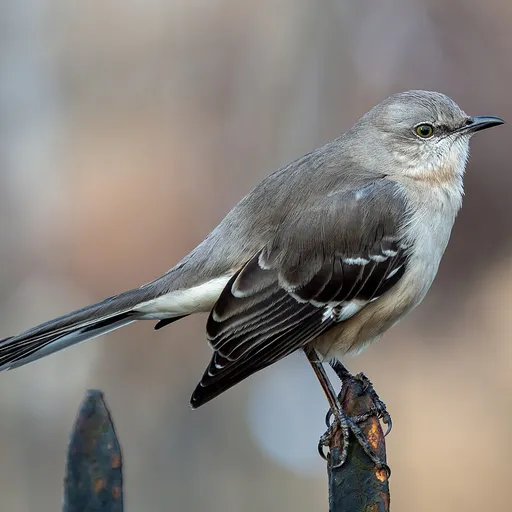
Northern Mockingbird
Mimus polyglottos
Least Concern
Listen
XC647073 · Eric Schneider · New York, New York County, New York, United States · CC BY 4.0
Overview
The northern mockingbird (Mimus polyglottos) is a medium-sized songbird native to North America, extending into parts of the Caribbean and the Hawaiian Islands. It is classified as a species of least concern by the IUCN Red List and is typically a permanent resident, although populations in northern regions may migrate south during winter.
Identification
- Medium-sized passerine with gray upperparts and white or whitish-gray underparts.
- Distinctive white patches on wings and tail, visible in flight, accompanied by parallel wing bars.
- Features long legs and a tail nearly as long as its body, measuring 20.5 to 28 cm in total length.
- Black bill with a brownish base and light green-yellow or yellow irises.
Habitat
This species prefers open areas with sparse vegetation, including suburban parks, mowed lawns with nearby shrubs, desert scrub, and chaparral. It avoids densely forested areas and breeds across the continental United States, parts of Canada, Mexico, and the Caribbean. While generally a year-round resident, northern populations may shift south during the winter season.
Diet
As an omnivore, the northern mockingbird consumes arthropods, earthworms, berries, fruits, seeds, and occasionally small vertebrates such as lizards. Its diet shifts significantly from animal prey during the breeding season to fruits in autumn and winter. Foraging occurs on the ground or in vegetation, often involving a peculiar two-step wing motion while searching for food.
Did you know?
These birds are renowned for their ability to mimic the calls of other birds and artificial noises, including electronic sounds. Studies have also demonstrated that they can identify individual humans and treat them differently based on learned threat assessments.
Sources
- Wikipedia · CC BY-SA 4.0
- Wikidata · CC0 1.0