
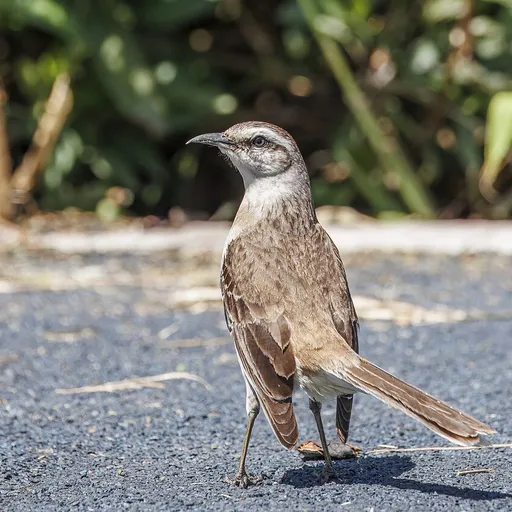
Chalk-browed Mockingbird
Mimus saturninus
Least Concern
Listen
XC1090717 · Pedro Sanetti · Cipolletti, General Roca, Río Negro, Argentina · CC0 1.0
Overview
The chalk-browed mockingbird (Mimus saturninus) is a bird in the family Mimidae, classified as Least Concern on the IUCN Red List. It is a common species with a large range across South America, estimated at 10,600,000 km².
Identification
- Length of 23.5 to 26 cm and weight of 55 to 73 g, with males slightly larger than females.
- Adults feature a dark brown crown, a broad white supercilium, a blackish line through the eye, and white cheeks.
- Upperparts are brownish with darker streaks and a buffier rump, while wings and tail are blackish with white tips or edges.
- Undersides are white from throat to vent, though the breast has a gray tinge and flanks are buffy with faint dark streaks.
- Song is described as a loud, varied series of notes, trills, and phrases, often including the mimicry of other species.
Habitat
This species inhabits open areas such as savannas, forest edges, open woodland, pastures with scattered trees, and urban or suburban gardens. It is generally found in lowlands but reaches up to 2,500 m in northern Argentina. Its range includes Brazil, Bolivia, Argentina, Paraguay, Suriname, and Uruguay.
Diet
The chalk-browed mockingbird is omnivorous, feeding on fruits, seeds, berries, insects, and other small vertebrates. It occasionally predates the eggs and nestlings of other birds. Foraging takes place mostly on the ground.
Did you know?
Although the species is territorial and monogamous, both related and unrelated helpers have been documented aiding in territory defense and caring for young.
Sources
- Wikipedia · CC BY-SA 4.0
- Wikidata · CC0 1.0