
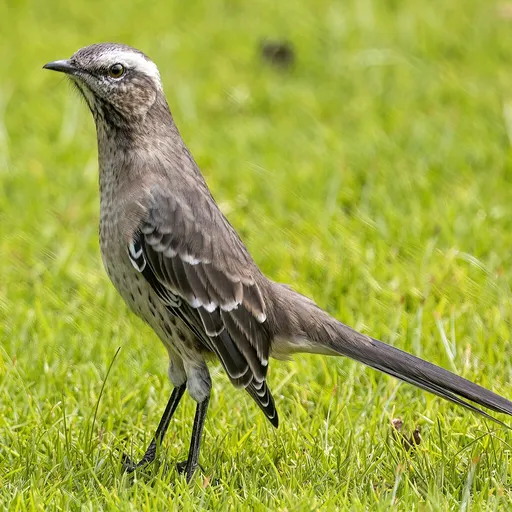
Chilean Mockingbird
Mimus thenca
Least Concern
Overview
The Chilean mockingbird (Mimus thenca), locally known as tenca, is a bird species in the family Mimidae that is primarily found in the northern half of Chile with some presence in Argentina. It is assessed as being of Least Concern by the IUCN due to its common presence within its range and lack of known threats.
Identification
- Length of 28 to 29 cm with a weight of 66 g, where males are slightly larger than females.
- Brownish-gray crown, neck, and back with darker streaks, blackish wings showing two narrow bars, and a tail with white edges on the outermost feathers and white tips on most others.
- A wide whitish supercilium, whitish throat, brownish-gray chest, dirty white belly, and buffy flanks with blackish streaks.
- Vocalisations consist of sweet, variable notes and phrases, with the species noted as an excellent mimic of other bird species.
Habitat
The species inhabits a wide variety of biomes characterised by scrub, shrubs, or widely spaced trees, including succulent coastal scrub, inland savanna bushland, and evergreen Chilean matorral. Its range extends from Copiapó Province in the Atacama Region south to Los Lagos, Puerto Montt, and Chiloé Island in Chile, as well as a small population in Neuquén Province, Argentina. It occupies elevations from sea level to 2,200 m but shuns Nothofagus and Cryptocarya woodlands in the south and pine plantations in central Chile.
Diet
The Chilean mockingbird is omnivorous, feeding on insects, wild and cultivated fruits, nectar, and occasionally small lizards. It forages mainly on the ground by turning over leaf litter and digging under fallen branches, while also hunting in vegetation up to 3 m above the ground.
Did you know?
Nests, which are constructed from twigs and lined with moss or wool, are often parasitised by shiny cowbirds (Molothrus bonariensis).
Sources
- Wikipedia · CC BY-SA 4.0
- Wikidata · CC0 1.0