
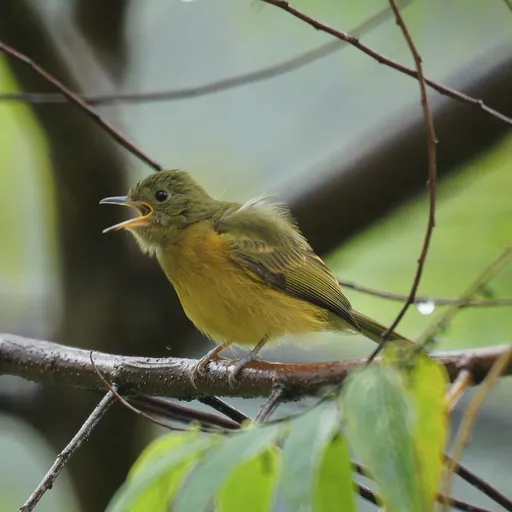
Ochre-bellied Flycatcher
Mionectes oleagineus
Least Concern
Listen
XC248169 · Niels Krabbe · Esmeraldas: Humedal de Yalare, Ecuador · CC BY-SA 4.0
Overview
The ochre-bellied flycatcher (Mionectes oleagineus) is a small tyrant flycatcher native to the tropical and subtropical zones of the Americas. Classified as Least Concern by the IUCN, it possesses an extremely large range with an estimated population of at least five million mature individuals.
Identification
- Measures 12.5 to 14 cm in length and weighs between 7.5 and 18.5 g, with both sexes sharing identical plumage.
- Features a greenish olive head, back, and rump, paired with rich cinnamon buff underparts and throat.
- Olive wings display wide buffy ochraceous edges on the tertials and thinner edges on the coverts that appear as wing bars, while the tail is dark grayish brown or dusky olive.
- Possesses a dark brown iris, a black maxilla, a black mandible with a paler base, and legs of various shades of gray.
Habitat
Found across Mexico, Central America, Trinidad and Tobago, and northern South America, this species generally inhabits the interior and edges of humid to wet evergreen and semi-deciduous forests. It also frequents secondary forest, gallery forest, plantations, gardens, and both várzea and terra firme forest in the Amazon Basin. Its elevation range varies by region, typically spanning from sea level to approximately 1,800 m.
Diet
Feeds on a variety of fruits and insects, usually foraging by itself or occasionally joining mixed-species feeding flocks at fruiting trees. It hovers and gleans food in short sallies from a perch and also picks items while perched, operating at all levels of the forest though mostly up to the middle level.
Did you know?
Males employ two distinct mating strategies, with roughly half the population courting singly and the other half at leks, where they sing, flash their wings, and erect their crown feathers. The species constructs a unique pear-shaped nest with a side entrance, suspended from a vine or aerial roots and lined with soft fibers.
Sources
- Wikipedia · CC BY-SA 4.0
- Wikidata · CC0 1.0