
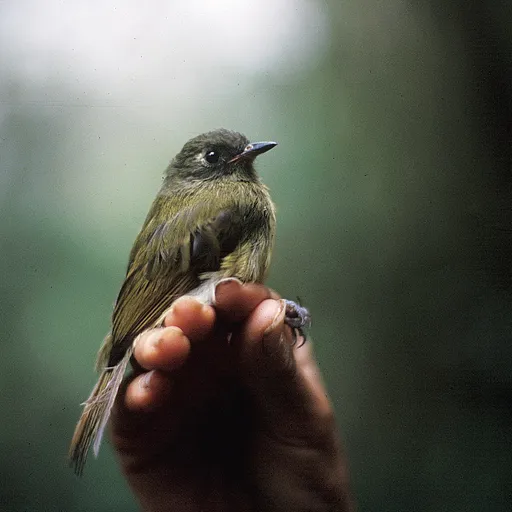
Streak-necked Flycatcher
Mionectes striaticollis
Least Concern
Listen
XC251134 · Niels Krabbe · Zamora-Chinchipe: above 'Cabañas Yankuam' 2 km S Las Orchideas, Nangaritza Valley, Ecuador · CC BY-SA 4.0
Overview
The streak-necked flycatcher, or Mionectes striaticollis, is a species of bird in the tyrant flycatcher family found across South America. It is classified as Least Concern by the IUCN, indicating it faces no immediate threats despite a potentially decreasing population.
Identification
- Size: 13 to 13.5 cm long, weighing 13 to 17 g.
- Plumage: Slatsy gray crown and nape with dark olive upperparts; throat and upper breast are slate-gray with white streaks; lower body is yellow with dark olive streaks on the flanks.
- Features: Dark brown iris, long dark brownish-gray bill with a pinkish base to the mandible, and dark gray legs and feet.
- Song: A series of rhythmic, squeaky notes often described as a melancholy, rising-falling 'urrEEew'.
Habitat
This species primarily inhabits humid montane forests in upper tropical and lower temperate zones, extending to forest edges and secondary growth. It is found in the Andes of Colombia, Ecuador, and Peru, as well as northern Bolivia, at elevations ranging from 500 to 3,300 m depending on the region.
Diet
It feeds on insects and small fruits, typically perching upright on branches to make short sallies for hover-gleaning from leaves and twigs, or by capturing flying prey on the wing. Foraging is usually solitary but may involve joining mixed-species feeding flocks.
Did you know?
Up to six males may display to females at a lek, singing and swinging their heads in synchrony. Its nest is a unique hanging bag made of plant fibers and moss, often suspended from a vine near a watercourse.
Sources
- Wikipedia · CC BY-SA 4.0
- Wikidata · CC0 1.0