
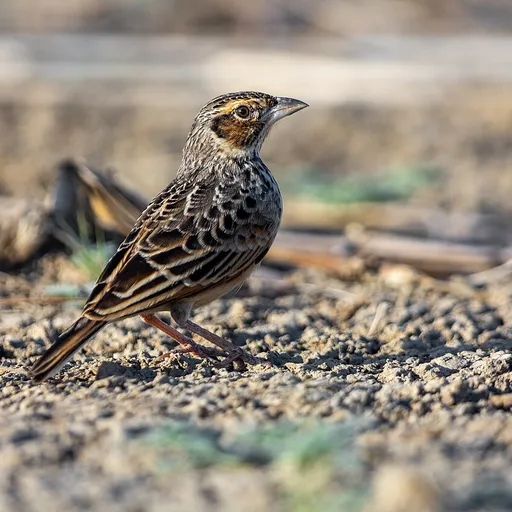
Singing Bush Lark
Mirafra javanica
Least Concern
Listen
XC1070545 · Rob Nicholson · Mosquito Creek Road, Coolmunda, Goondiwindi Regional, Queensland, Australia · CC BY 4.0
Overview
The singing bush lark, also known as Horsfield's bush lark, is a species of lark found throughout most of Australia and much of Southeast Asia. It is classified as Least Concern on the IUCN Red List and is the only lark species occurring naturally in Wallacea, New Guinea and Australia.
Identification
- Small, thickset bird with a large head, short sparrow-like bill, and a small crest that is only visible when raised.
- Dorsal plumage is brown, reddish, or sandy with darker central streaks; features a buff eyebrow and pale underparts.
- Wings are short and rounded with a distinctive rufous panel, and the tail is white-sided but only half the length of a skylark's.
- In flight, it exhibits jerky wing beats with the head slightly raised and tail depressed, often hovering or fluttering before landing, and produces a slurred chirrup when flushed.
Habitat
This species inhabits a wide range of open environments, including grasslands, shrublands, heathlands, dunes, and modified habitats such as cropland and pasture. In Australia, it occurs from the Eyre Peninsula to Shark Bay, acting as a summer migrant in the south-east and a vagrant to Tasmania. Its global range extends from Myanmar to Australia, covering an estimated 10,000,000 km².
Diet
The singing bush lark is a terrestrial, omnivorous forager that uses its short, stout bill to crush seeds and glean or probe for food on or just below the ground surface. Its diet consists mainly of grass seeds and invertebrates, with an increased consumption of insects during the breeding season. It typically forages alone, though it may occasionally be found in small parties.
Did you know?
This lark is an exceptional mimicker that can sustain a melodious song interspersed with the calls of other species, even rendering the 'tink, tink' of birds that have long vanished from the district, suggesting it either possesses considerable memory or acquires calls through migratory wanderings.
Sources
- Wikipedia · CC BY-SA 4.0
- Wikidata · CC0 1.0