
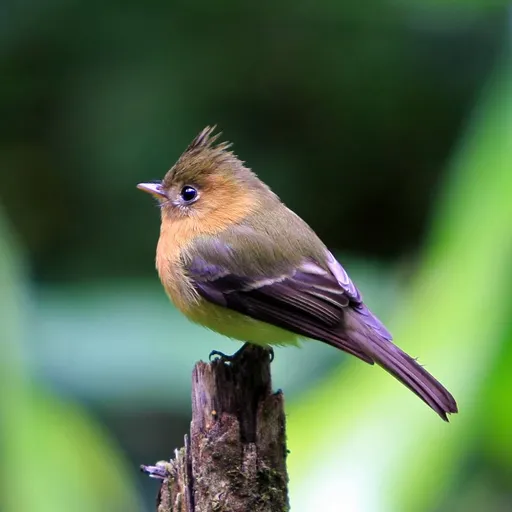
Northern Tufted Flycatcher
Mitrephanes phaeocercus
Least Concern
Listen
XC251136 · Niels Krabbe · Esmeraldas: Canandé, Ecuador · CC BY-SA 4.0
Overview
The northern tufted flycatcher is a small passerine bird in the tyrant flycatcher family, found in wooded montane landscapes from Mexico to Ecuador. It is assessed as a species of Least Concern on the IUCN Red List, with an estimated population of at least 500,000 mature individuals.
Identification
- Length of 12 to 13.5 cm and weight of approximately 8.5 g, with an erect pointed crest on the crown.
- Nominate adults feature a brown-tinged olive crown, a pale spot above the lores, and a thin buff-white eye-ring on a cinnamon face, with brownish upperparts and two buff wing bars.
- Underparts range from bright ochre to cinnamon on the throat and breast, with an ochre-yellow belly, and legs that are blackish.
- The dawn song is described as a rapid series of high notes, 'bip-bip-bip-dididi-up-bip-bip-bibibiseer', accompanied by single or repeated 'tchwee' or 'turee' notes.
Habitat
This species inhabits a variety of wooded montane landscapes in the upper tropical to lower temperate zones, including pine, pine-oak, evergreen, and secondary forests, as well as open areas and gallery forest. It tends to favour forest edges, gaps, and clearings, with elevations ranging from near sea level in Colombia to 3,000 m in northern Central America.
Diet
The northern tufted flycatcher feeds on insects, typically foraging singly or in pairs at any level of the forest, primarily at mid-level. It employs hawking behaviour, sitting upright on a perch to capture prey in mid-air with sallies, often returning to the same perch and shivering its wings and tail when landing.
Did you know?
The nest is an open cup constructed from moss, liverworts, and lichens, lined with softer material and placed between 4 and 27 m above the ground, sometimes in the saddle of dangling vines or hidden in epiphytes on a tree branch.
Sources
- Wikipedia · CC BY-SA 4.0
- Wikidata · CC0 1.0