
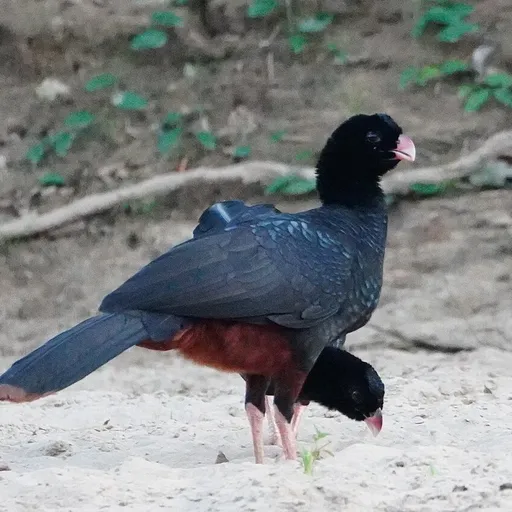
Crestless Curassow
Mitu tomentosum
Least Concern
Overview
The crestless curassow (Mitu tomentosum) is a species of bird in the family Cracidae, which includes chachalacas, guans, and curassows. It is a large, ground-dwelling bird found in parts of South America.
Identification
- Length of 75 to 85 cm (2.5 to 2.8 ft), with males weighing 2,300 to 3,050 g and females 1,300 to 2,425 g.
- Mostly black plumage with a dark blue to purplish gloss, featuring a rich chestnut belly and tail tip.
- Distinguished from other curassows by the absence of a crest and any swelling on its red bill.
- Vocalisations include a low humming or booming 'uuut ... uu-UU-uu-uhoot', with alarm calls consisting of sharp, reedy whistles.
Habitat
The species is found in eastern Colombia, southern Venezuela, northwestern Brazil, and southwestern Guyana. It inhabits lowland rainforests, particularly along rivers, and gallery forests in the llanos of Colombia and Venezuela, favouring areas with thick undergrowth.
Diet
The bird mostly feeds on the ground, usually foraging singly or in pairs, though it may occasionally be seen in groups of up to ten. Its diet is reported to consist almost entirely of fallen fruits.
Did you know?
Genetic analyses reveal that the crestless curassow is the sister species to the Alagoas curassow, the only other Mitu species with brown eumelanin in its tail tip.
Sources
- Wikipedia · CC BY-SA 4.0
- Wikidata · CC0 1.0