
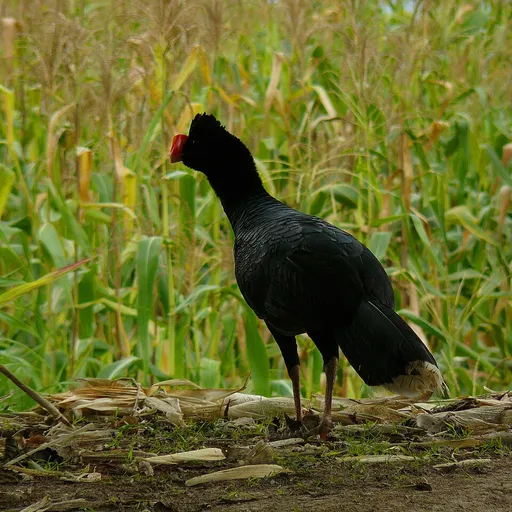
Razor-billed Curassow
Mitu tuberosum
Near Threatened
Overview
The razor-billed curassow (Mitu tuberosum) is a monotypic species in the family Cracidae. It is assessed as Near Threatened by the IUCN due to a declining population, despite having a very large range.
Identification
- Plumage is mostly black with a strong purplish blue gloss, featuring a chestnut lower belly and white-tipped tail feathers.
- Size is 83 to 89 cm long, with males weighing about 3,860 g.
- Features a tall ragged crest and a large, bright red, laterally compressed bill.
- Song consists of a series of deep booming notes, described as 'BMMM mmMMM... mmMMM'BMMM-BMMM', often sung at dawn.
Habitat
Found in much of Amazonia, including eastern Peru, northern Bolivia, northern Brazil to the Atlantic coast, southeastern Colombia, and extreme northeastern Peru. It inhabits lowland evergreen forest, including terra firme, gallery, and várzea forests, as well as the margins of lakes and streams. Elevation ranges from sea level to 1,350 m.
Diet
Typically forages alone or in pairs on the forest floor. Its diet consists mainly of fallen fruits, but also includes leaves, insects, fungi, and small vertebrates.
Did you know?
The nesting season in northern Peru spans from November to February, and the nest is described as a perfect round cup made of branches, lianas, and leaves.
Sources
- Wikipedia · CC BY-SA 4.0
- Wikidata · CC0 1.0