
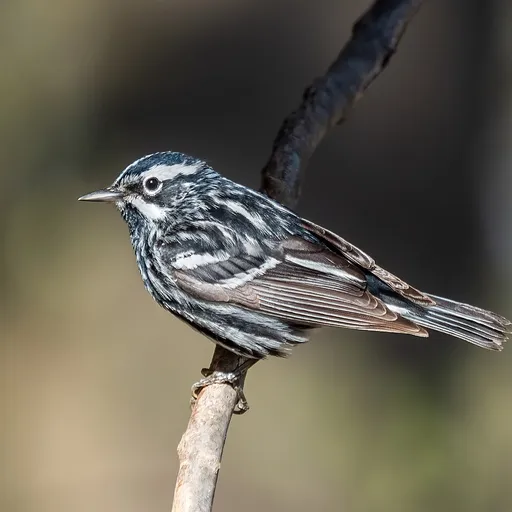
Black-and-white Warbler
Mniotilta varia
Least Concern
Listen
XC613378 · Doug Hynes · West Brook Ecological Reserve, Newfoundland and Labrador, Canada · CC BY-SA 4.0
Overview
The black-and-white warbler (Mniotilta varia) is a species of New World warbler and the only member of its genus. It is a migratory bird that breeds in northern and eastern North America and winters across the Americas, with vagrant records in northern Europe.
Identification
- Length 11 to 13 cm with a mass of 8 to 15 g, featuring a boldly streaked black and white plumage described as a 'flying humbug' in breeding males.
- Distinguishing features include a white eyebrow, two white wing bars on black wings, a black tail, and a black-and-white streaked back.
- High-pitched song consisting of a repeating 'wee-see' phrase, accompanied by chip and 'seet-seet' calls.
Habitat
Breeding populations occupy mature deciduous or mixed forests, often in wetter areas or swamps, though second-growth forest is also used. During migration, the species prefers forest and riparian areas, while in wintering grounds it is a habitat generalist found in mangroves, cloud forests, and even shade coffee plantations.
Diet
This warbler feeds primarily on insects and spiders, including lepidopteran larvae, beetles, and ants. Uniquely among North American wood-warblers, it forages on bark like a nuthatch, using its short legs and long hind toe to move up and down tree trunks, though it also gleans insects from leaves.
Did you know?
It is the only North American wood-warbler that forages on bark, moving up and down tree trunks in a manner similar to a nuthatch.
Sources
- Wikipedia · CC BY-SA 4.0
- Wikidata · CC0 1.0