
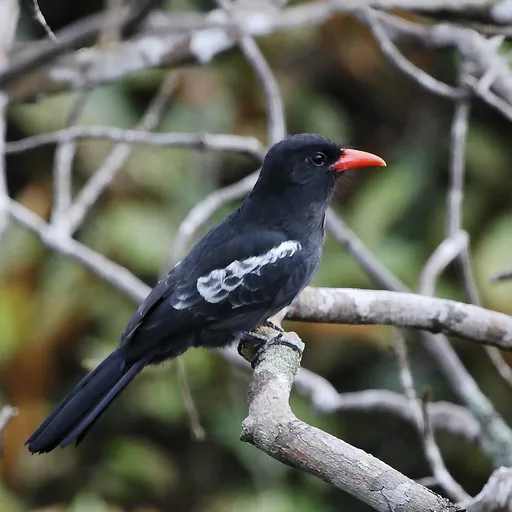
Black Nunbird
Monasa atra
Least Concern
Overview
The black nunbird (Monasa atra) is a species of near-passerine bird in the family Bucconidae. It is native to northern South America, where it is considered common and is listed as Least Concern on the IUCN Red List.
Identification
- 25 to 29 cm long, with glossy blue-black upperparts and dark to light gray underparts.
- A wide white band is visible on the closed wing from the lesser coverts.
- The bill is red, the eye is red to brown, and the legs and feet are slaty black.
- Vocalisations include a flute-like 'whoo-doo-doo' and descending 'hyoo-hoo-hoo-oo-oo-oo', alongside calls such as 'yawkl-diddl'.
Habitat
Found in southern and eastern Venezuela, the Guianas, and northern Brazil, and possibly eastern Colombia. It inhabits humid terra firme, gallery, and várzea forest, typically near water or at forest edges. It occupies all levels of the forest from the understory to the canopy, ranging from sea level to 1,000 m in elevation.
Diet
It forages by sallies from a perch, plucking prey from vegetation or occasionally catching it in flight. Its diet consists of insects, spiders, other invertebrates, and small vertebrates such as lizards, and it is known to follow army ant swarms.
Did you know?
The generic name Monasa is derived from the Ancient Greek word for 'solitary', despite the species being common and occurring across a very large range. Immature birds are distinguishable from adults as they appear sootier above and browner below.
Sources
- Wikipedia · CC BY-SA 4.0
- Wikidata · CC0 1.0